
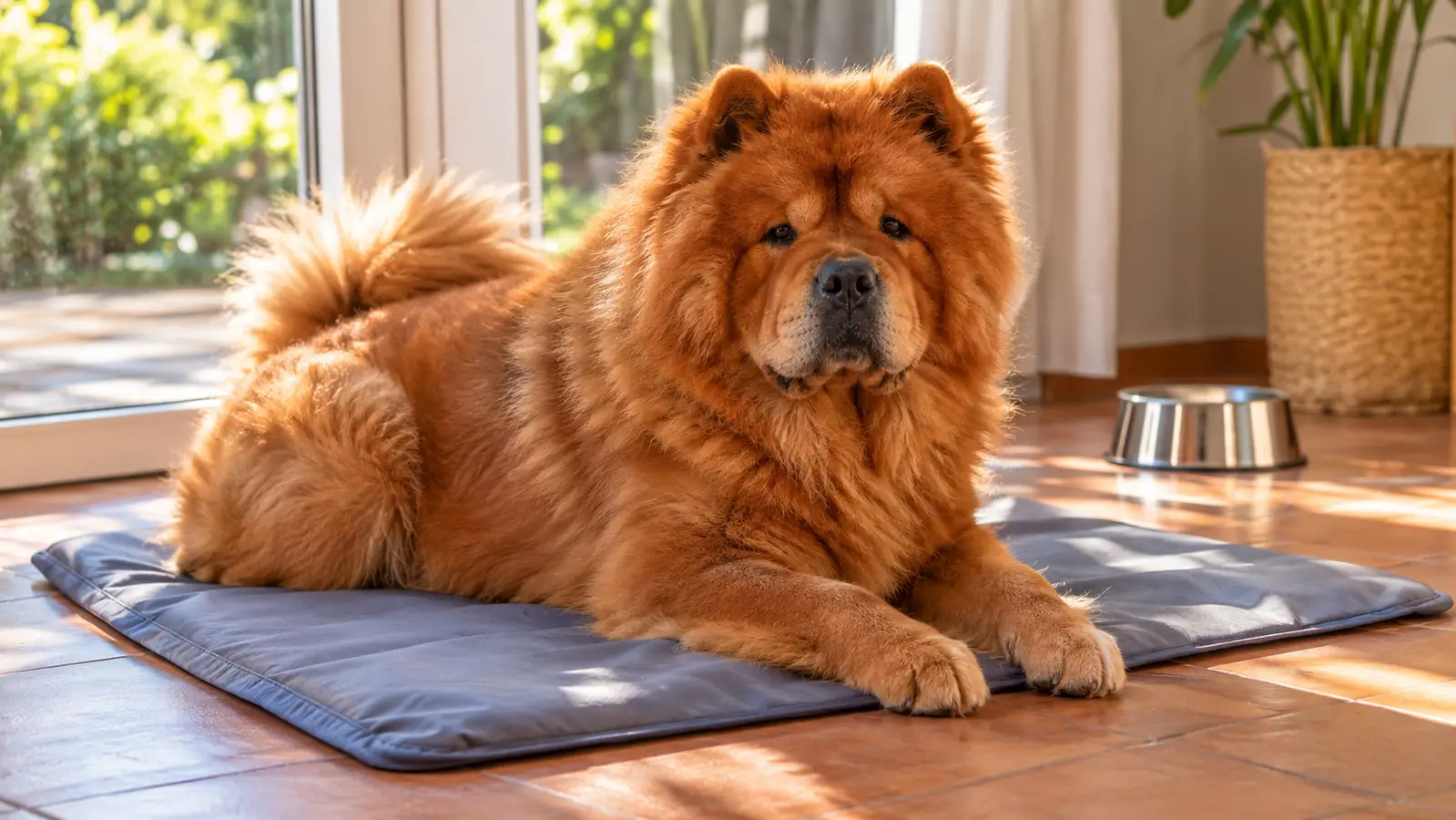
By ten in the morning in July, the tile in my kitchen is already warm under my bare feet, and Bruno is flat on it with his legs splayed out like a dropped rug. He is seven years old, sixty-four pounds, cinnamon red with a ruff you could lose a hand in, and once the thermometer passes about eighty he pants like he has been running uphill. Fort Collins summer is dry and bright and it does not cool off much before nine at night. I am not a vet and I am not a professional groomer. I am just the person who has lived with one Chow Chow for seven years and figured out what actually helps him between June and September, mostly by watching what he ignored.
The things people suggest did not work for us. I thought about shaving him for roughly four minutes one August, then read enough to know better, and I have never done it. What finally made a difference was unglamorous: a MARUNDA cooling mat, the 36 by 24 inch size, laid on the kitchen tile by the patio door. A wet towel got one long sigh out of him. I bought a basic elevated cot in the summer of 2025 and he walked around it for three months like it was furniture that had offended him. He claimed the mat on the first hot day in June 2026 and used it until I put it away in October. What follows is the order I would do it in if I were starting over, and the things I would do around the mat, because a mat by itself is not a plan.
The One Square of Floor He Actually Chooses in July
Bruno is sixty-four pounds and the 36 by 24 inch size fits him curled up. No gel, no water, nothing to plug in, just a cool-touch face on the tile by the patio door. If your Chow has already picked a spot, start there instead of arguing with him.
Amazon Check Today's Price on Amazon →Step 1: Put the Mat Where He Already Lies Down
Watch your dog for two days before you buy anything. Not where you would like him to lie. Where he actually lies at two in the afternoon, when the day is at its worst. For Bruno that was the kitchen tile by the patio door, on the north side of the house, where the glass throws a flat grey light and the floor stays cool even when the air does not. It was not the living room carpet, which is where I would have put a nice dog bed, and it was not the shaded patio, which he uses mostly in the evening. If your Chow has already picked a square of floor, that square is your answer.
Size is the next decision, and it is not about the biggest number on the page. I bought the 36 by 24 inch size, which the listing calls Large-Crate. Bruno is sixty-four pounds. Curled up, which is how he actually sleeps, he fits with room to spare. Stretched out flat, his back legs hang off the edge. That is not a defect in the mat. That is a large dog using a mat sized for a large crate, and he has never once complained about it. A smaller mat would have been money spent for nothing. A bigger one would not have made him any cooler.
Then look at what is underneath it. A cooling mat is a contact product, which means it does the most good where his belly is actually touching it. The MARUNDA mat is 0.6 of an inch thick, filled with a soft filler, and made of a nylon and PE blend that feels cool to the hand rather than cold. There is no gel pack, no water to fill, nothing to put in the freezer and nothing to plug in. On tile it stays comfortable through an afternoon. On carpet, which insulates, it is closer to a soft bed. That is the whole reason ours lives on the kitchen floor and not in the room with the nice furniture.
Step 2: Let Him Claim It Instead of Showing Him
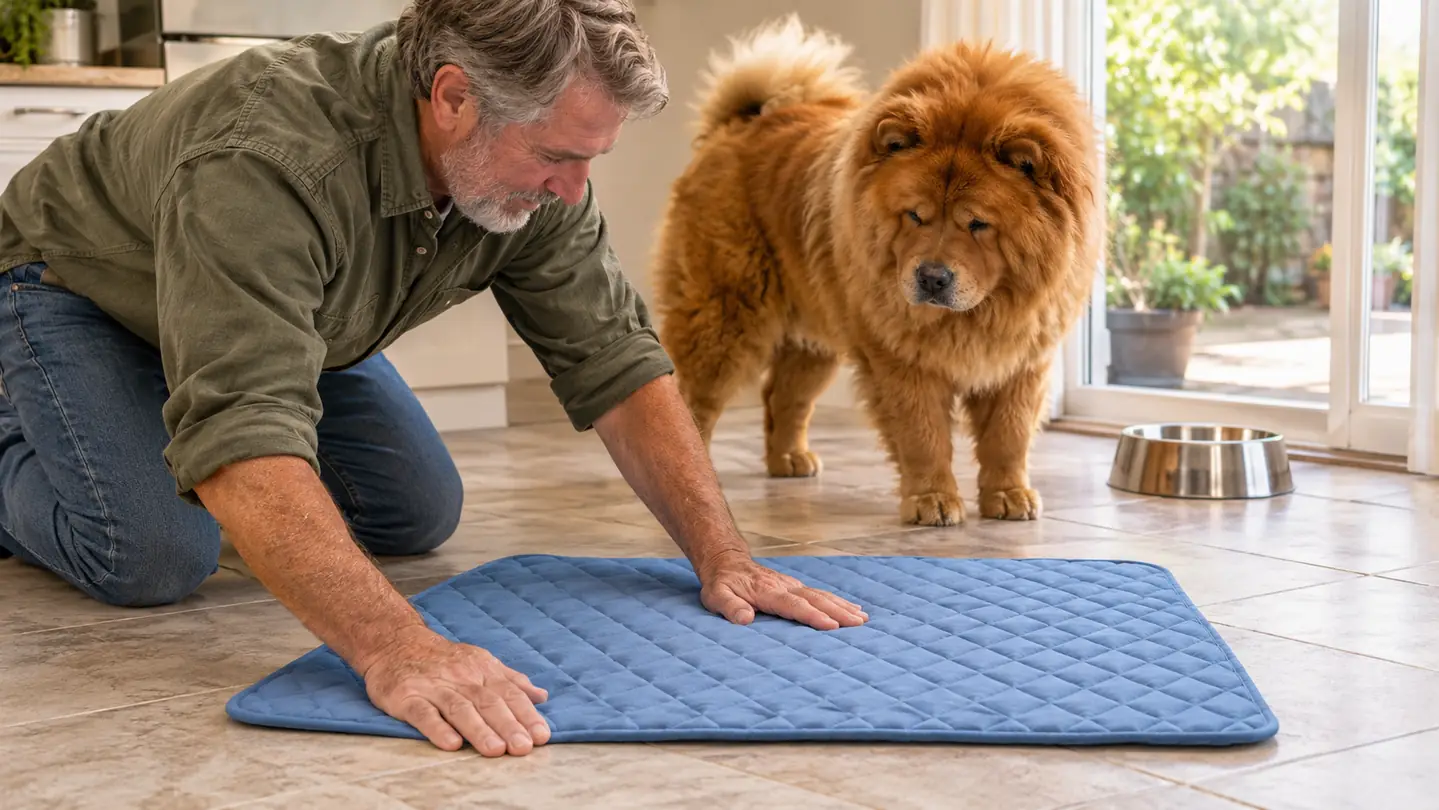
The first genuinely hot day in June, I unfolded the mat, set it down on the tile, and walked away without a word. Ten minutes later he was on it. Had I stood there patting the thing and calling his name in a bright voice, he would have gone and lain in the hallway out of principle. That is not a Chow thing exactly, but it is very much a Bruno thing, and I have stopped pretending otherwise. With this breed, the fastest way to make something appealing is to look like you do not care whether they use it.
Three things defeat a mat like this. The first is covering it with a blanket or a thin towel because it looks cozier, which puts a layer between the dog and the cool-touch face and turns it back into a floor cushion. The second is putting it inside a crate he only sees at bedtime, so it becomes associated with being shut in rather than with relief. The third is moving it every day because you think it would be nicer in the sun, or nearer the sofa. Pick the spot and leave it there for a week. Dogs build habits around geography, and a mat that moves is just an object.
If he ignores it anyway, try timing rather than persuasion. Put him on it right after a walk, when he is already hot and looking for somewhere to collapse. Try the worst hour of the afternoon instead of the morning. And if he still walks around it, believe him and stop. Some dogs genuinely prefer bare tile and there is nothing wrong with that. Bruno ignored the elevated cot for an entire summer, and I finally accepted that the cot was for me and the tile was for him. The mat worked because I stopped trying to improve on the floor he had already chosen.
Step 3: Build the Day Around the Mat, Not On It
A cooling mat is not air conditioning, and I would rather say that plainly than have you find out in August. It feels cool rather than cold. It does not lower the temperature of the room, it does not blow air, and it does not help a dog standing in the sun ten feet away from it. What it does is give a hot dog one reliable place to put his belly. That is worth a lot. It is also not a substitute for shade, water, or changing when you walk.
Our summer schedule is built around not being out in the middle of the day. Bruno gets his long walk before eight, when the pavement is still cool enough to hold a hand on, and a short one after eight in the evening. Between those, he is in or under something, and the mat sits in that gap. On the days I have ignored my own rule and taken him out at two in the afternoon, the mat did not rescue the decision. He came in, drank, lay on it for an hour, and was flat for the rest of the day. The mat helps a dog who is already being managed. It does not fix a day that was planned badly.
Two water bowls, both refreshed in the morning. One on the shaded patio, one in the kitchen a few feet from the mat, because a dog who is too hot to move will not cross the house for a drink. And know what your own dog looks like when he is in trouble rather than just uncomfortable. Bruno's panting gets fast and shallow and he stops settling, up and down and up again. That is my signal to bring him in, wet his chest and belly with cool water, and call Dr. Nwosu if he does not come around. In seven years that has happened once, and once was plenty.
Curled up, Bruno fits on the 36 by 24 inch mat with room to spare. Stretched out flat, his back legs hang off the edge. He has never complained about it once.
Step 4: Keep the Coat Working So the Mat Has Something to Work With
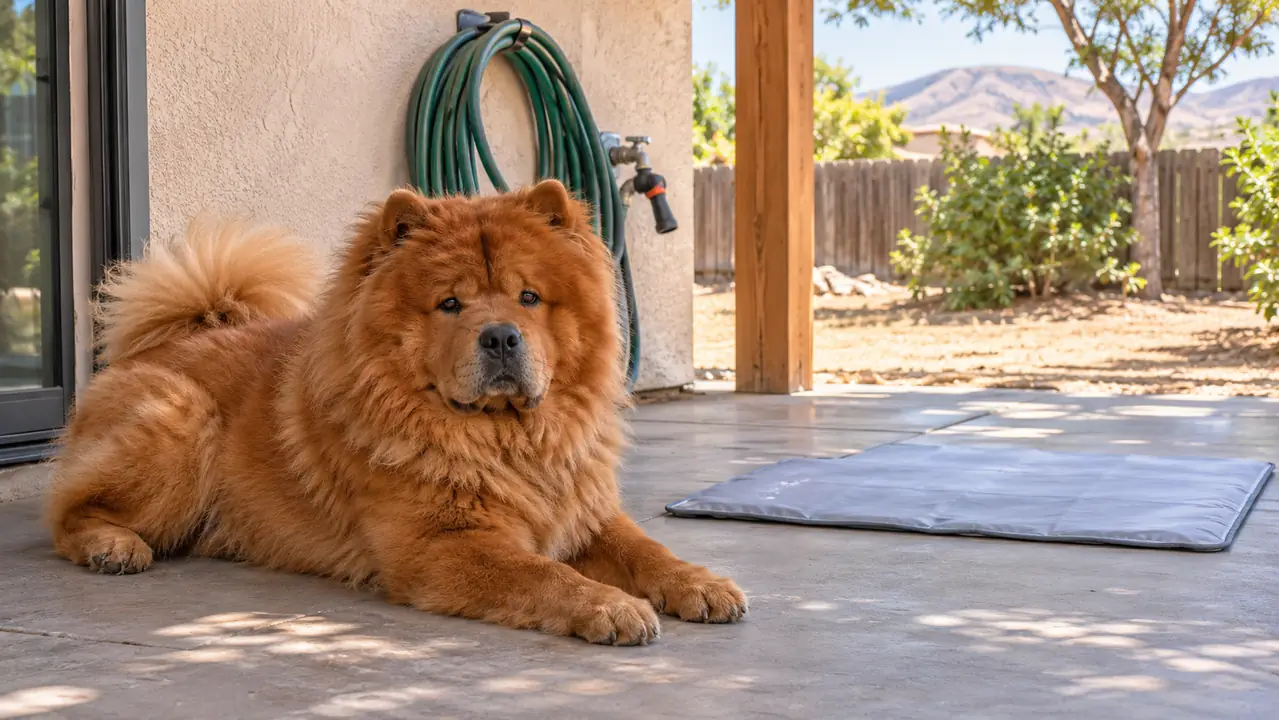
Here is the part that matters more than the mat. A Chow's coat is not the problem in summer, it is the insulation, and it only insulates if air can move through it. A matted coat traps heat against the skin. A dog with packed undercoat can lie on a cooling mat all afternoon and still run hot, because the mat is cooling a layer of felt. Two summers ago I could feel the difference with my hand, flat and dense on the surface and warm underneath, especially under the ruff and behind the ears.
My tools are dull and I use them in the same order every week. The slicker brush comes out daily, about five minutes in the evening, working the ruff, behind the ears and the feathered pants on his back legs. Within three weeks of starting that in January, the mats behind his ears had stopped forming at all. The undercoat rake is the weekly tool, Sunday mornings on the patio, twenty to thirty minutes, and twice a week during the coat blows in April and May and again in October. On the rake, the seventeen-tooth side does the thinning and deshedding. The nine-tooth side is only for mats and tangles, and only when the skin underneath is not already irritated. The two tools do different jobs and neither replaces the other.
What I will not do is shave him. I am not a groomer and I will not pretend to be one, but I have read enough and watched enough to believe the coat is doing work in both directions. The other reason I keep after the ruff is the hot spot he had in August 2025, on his neck under all that hair, which Dr. Nwosu treated. It healed and he has not had one since, and I would like to keep it that way. A dry coat with air in it is a big part of that. A hot spot under a damp ruff in July is a miserable week for everybody.
Step 5: Wash It Monthly and Put It Away in October
The mat gets washed about once a month, on gentle, and air dried flat on the patio table. Hair and dust work into the surface over a few weeks, and a mat holding a layer of Chow undercoat is not cooling anything. Washing it is the least interesting job in this whole routine and the one I notice most when I skip it. It goes back down on the same tile by the same door, and he finds it again within an hour.
In October, when the nights drop into the forties, I wash it one last time, dry it, and put it away. The MARUNDA mat has one job and one season here. It comes back out in June, not in May, because a Chow will lie on a mat in fifty degree weather out of habit and there is no reason to encourage that. Storing it flat rather than crushed under something heavy keeps the filling where it belongs.
And know when a mat is not the answer. If your dog is panting hard at rest, if he cannot settle anywhere, if his gums look wrong, that is a vet call and not a shopping decision. Bruno has mild hip dysplasia that Dr. Nwosu found on X-rays in February 2026, and heat makes him stiffer and slower than cold does. The mat helps keep him off the hot patio at three in the afternoon, and that is all it does. It is not medicine and I would not want anyone reading this to think I said it was.
What Else Helps
The best thing in my yard is not a product. It is the north side of the house, shaded from about one in the afternoon onward, with a patio that stays dry. If you have shade, use it and stop shopping. If you do not, a shade sail or an awning will do more for your dog than anything on this page, including the mat.
The high velocity dryer earned its place for one reason. Before February 2026, bath day meant a stack of old towels and about three hours of air drying, and Bruno spent the rest of the day damp under the ruff, which is exactly the condition that made that hot spot possible in 2025. Now a bath every six weeks takes about forty minutes of drying, on the lowest heat, nozzle moving, never near his face or ears. It is loud, and he hated it for two baths and stood for it by the third. That change has done more for his skin than any summer product I have bought.
The elevated cot stays on the patio and he uses it in October, which tells you what he thinks of it in July. Some dogs love them. Mine does not. Water bowls, a wading pool if your dog will use one, and keeping his weight steady so his hips are not carrying more than they need to, all of that is duller than a cooling mat and all of it matters. The joint chews he has taken since February 2026 belong in the same category. They are not a summer item. They are part of the same effort, which is a seven year old Chow who still gets up easily in the morning.
One Cool Square of Tile, and a Dog Who Chooses It Himself
The MARUNDA mat lives by my patio door from June to October and does exactly one job. It is not air conditioning and it is not a replacement for a walk before eight in the morning. It is the spot he picks at two in the afternoon, and for a Chow that is worth more than it sounds.
Amazon Check Today's Price on Amazon →