
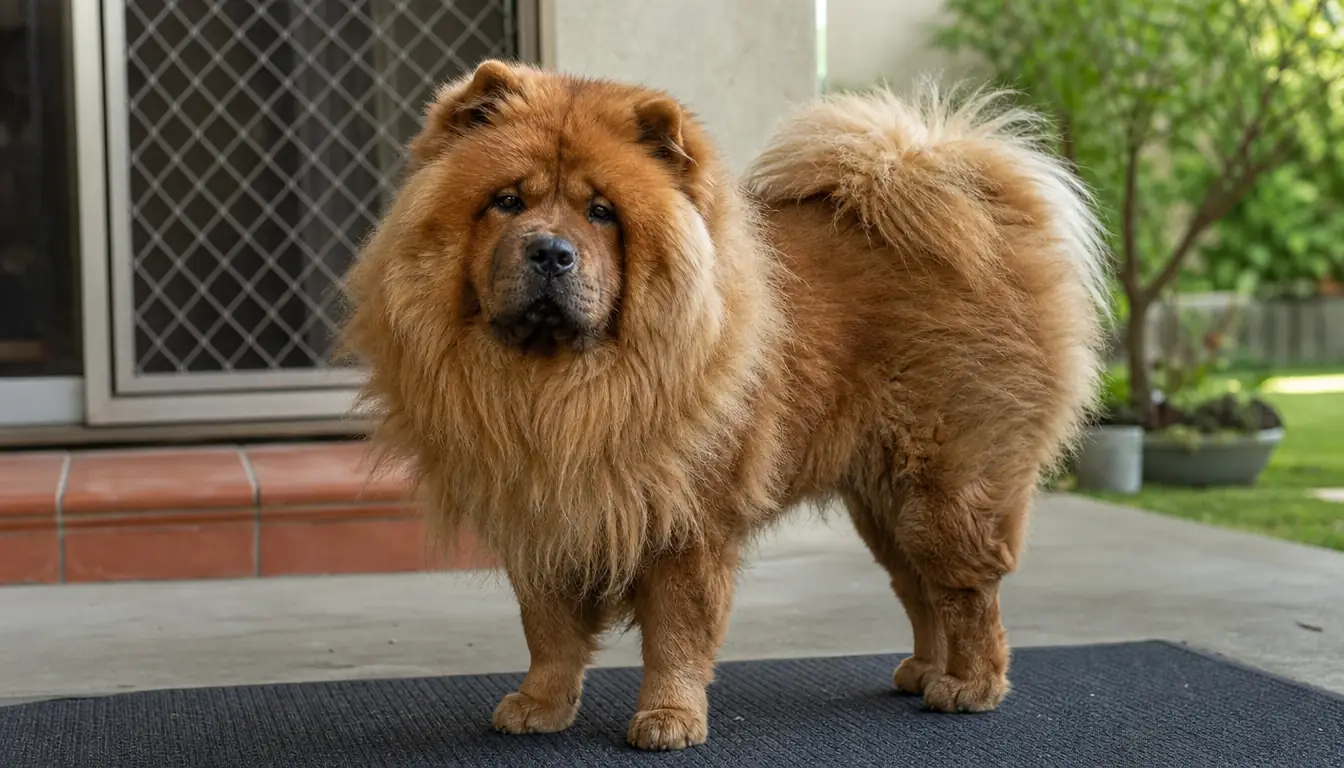
Bruno does not enjoy being brushed. He is a 7-year-old cinnamon red rough-coat Chow Chow, 64 pounds, and he tolerates grooming the way a cat tolerates a bath. He stays put. He sighs. He stares at the fence until I am finished. What he will not tolerate is pulling. One yank through a mat behind his ear and he is off the mat and across the patio, and the session is over for the day.
For years I fought those mats with a metal comb, a pin brush, and a blade-style deshedding tool from the pet store that I finally retired in 2025. The blade tool did pull hair. It also left his guard coat looking cut and ragged along the flanks, like a bad haircut on a good suit. In January 2026 I bought a Maxpower Planet undercoat rake in the same order as a self-cleaning slicker brush, mostly because I wanted to stop fighting tangles with a comb. Ten months later it is the tool I reach for every Sunday morning. It is not the tool I reach for every day, and that distinction matters more than anything printed on the package.
The Quick Verdict
The best mat tool I have owned for a double coat, and worth the 20 minutes every Sunday. It will not stop a Chow from shedding, and it is not a replacement for a daily brush.
Amazon Check Today's Price →The rake that got through the mat behind his ear without a fight
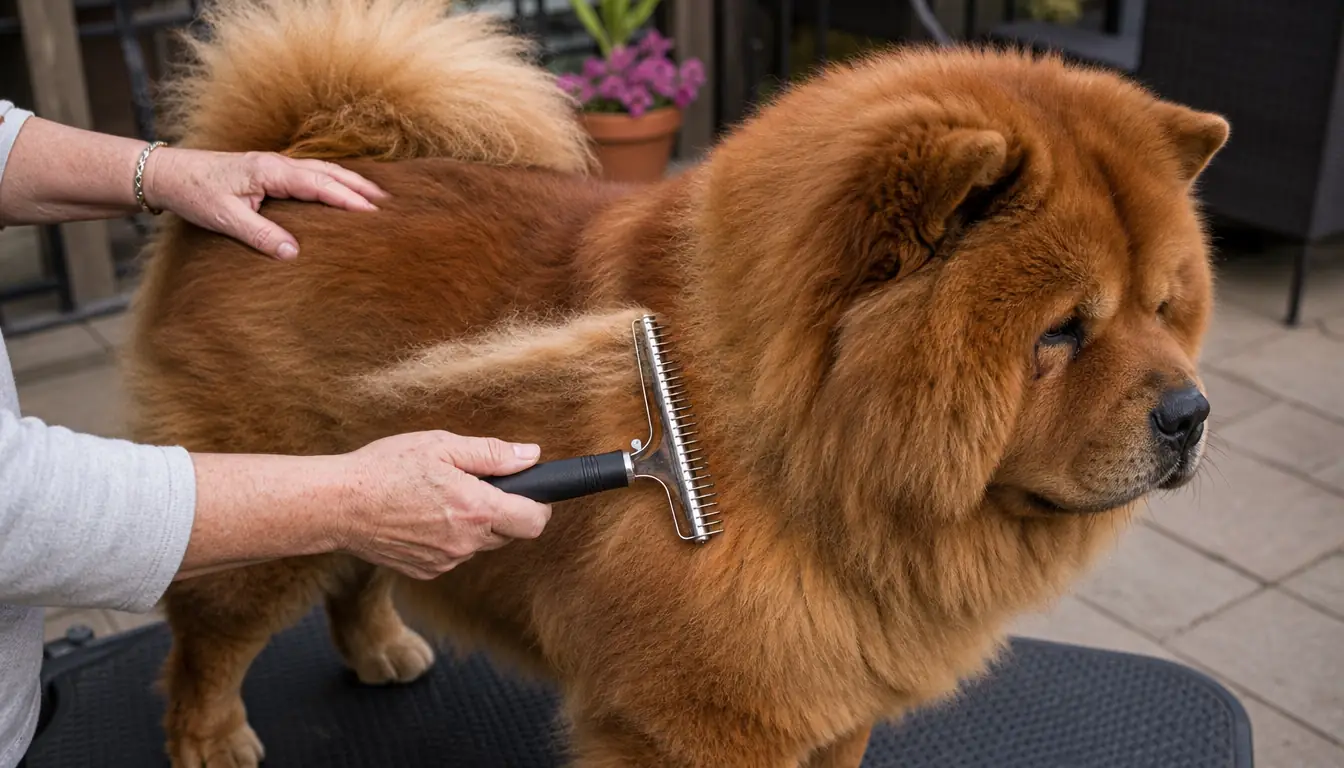
Two sides, one job each. Nine teeth break up the mats. Seventeen teeth pull the loose undercoat out in handfuls. Ten months on a 64-pound Chow and it is still the first thing I pick up on Sunday morning.
Amazon Check Today's Price on Amazon →How I've Used It
Sunday morning, after breakfast, out on the north patio. There is a rubber mat out there that is Bruno's mat and nobody else's, and he steps onto it because that is the routine, not because he is thrilled about the plan. I work for 20 to 30 minutes and then I stop, whether or not I have finished. Push past 30 and he starts lifting a back foot, and once a back foot goes up I have lost him for the week.
During the coat blows, which for him means April into May and again in October, I go twice a week instead of once. That is the schedule that keeps the house from turning into a snow globe. The other eight months, Sunday alone holds the line.
Position matters more than people expect. He stands, I sit on a lawn chair, and I work from the back half forward. Back half first, because that is where the undercoat is thickest and where he is most willing to cooperate. If I start at the ruff he is finished before I get to his back legs. Learn the order your own dog prefers and the whole job gets shorter.
There is no grooming table in this house and there never will be. That is worth saying plainly, because most of what you read about coat care assumes a setup that would cost more than my first car. A rubber mat on concrete, a lawn chair, and a dog who knows the order of events is the entire operation.
The rest of the kit is not complicated. The slicker brush gets about five minutes in the evening on the ruff, behind the ears, and the feathered pants on his back legs. The rake does the deep work once a week. A high velocity dryer comes out on bath day, roughly every six weeks, and that is the only day it comes out. I have never given him fish oil and I have never had him shaved, and I do not intend to start either one. He is 7 and his coat is the coat he was born with.
The rake and the dryer are more related than I expected. A coat dried down to the skin sheds out faster than a coat that stays damp under the ruff for two days, and before I had a dryer I was drying him with old towels and air and getting nowhere. The rake also works better on a coat that is genuinely dry. A damp undercoat clumps, and a clump is a mat waiting for a Tuesday.
One more habit, and this one took me a while. I keep a plastic bag clipped to the chair and I strip the teeth into it every few strokes instead of every few minutes. On a heavy day the rake fills up fast, and a head packed with fur stops doing anything useful. Empty teeth cut the whole session by a noticeable amount.
What the Two Sides Actually Do
The Maxpower Planet rake has an oblong head about 6 and a half inches long and 4 inches wide, and the whole tool weighs 4.6 ounces. The teeth are stainless steel, sharpened but rounded at the tips. The handle is rubber with a nonslip grip. There are two rows of teeth on opposite sides of the head. Nine teeth on one side. Seventeen on the other. That is the entire design, and it is the reason the tool works.
The 9-tooth side is for mats and tangles. Nine teeth means wider gaps, so each tooth gets under the knot instead of raking across the top of it. The way to use it is from the edge of the mat inward, short strokes, a little at a time. Go at the middle of a hard knot head-on with any tool and your dog will tell you exactly what he thinks of your technique.
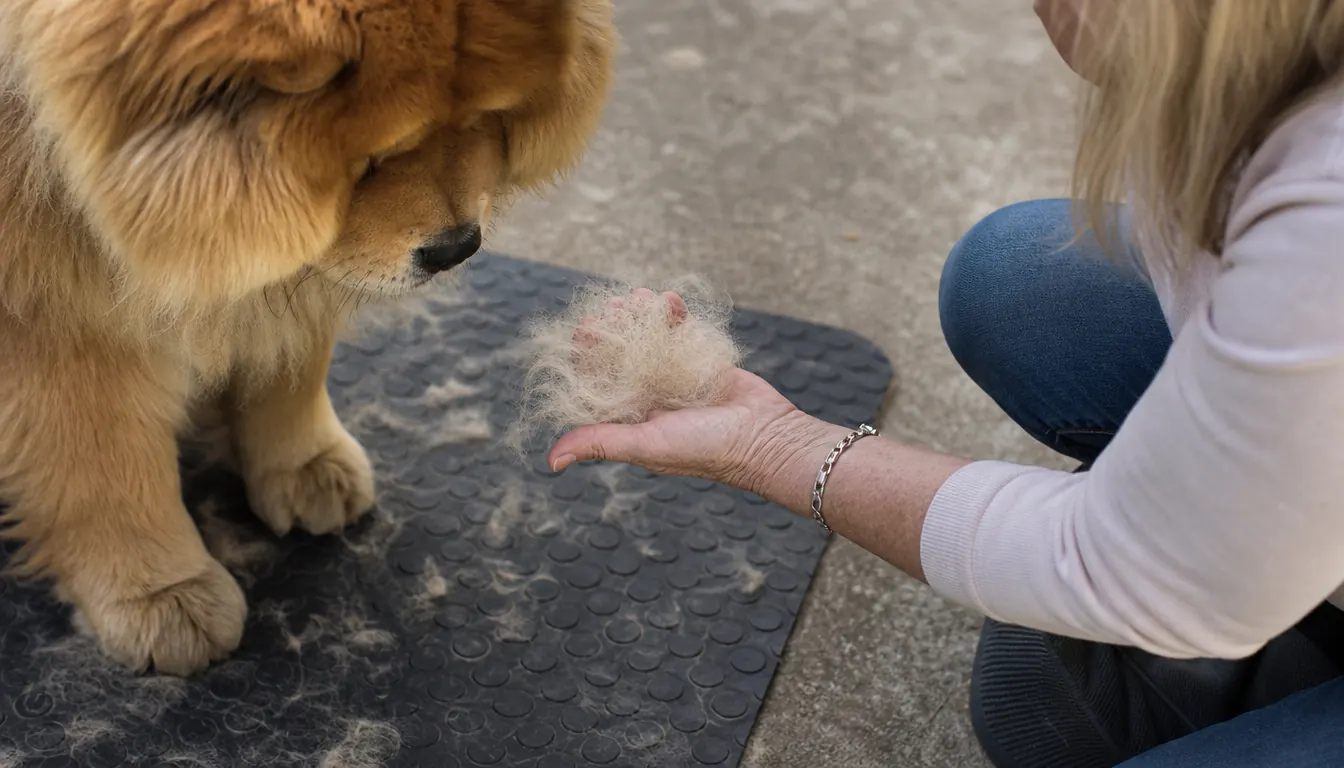
The 17-tooth side is the deshedding side. Closer teeth, more of them, and it lifts the loose undercoat in a way the 9-tooth side cannot. I work it along the spine, down the flanks, and through the ruff in sections, with the grain, long slow strokes. The hair comes up in pale handfuls. It is startling the first time and routine by the third Sunday.
The rubber handle does not spin in your palm when it is July and your hand is sweaty and the other hand is already holding a fistful of fur. Cleaning is the low-tech part. The hair gathers in the teeth, you pull it out with your fingers, and you are done. Nothing retracts, nothing clicks, nothing to break. For a tool that lives on a patio in Colorado weather for ten months, that matters.
What I Used Before, and Why It Failed
The metal comb was fine at the surface and useless against anything packed. It sat on top of a mat and slid. The pin brush was worse, partly because the pins bend and partly because a pin brush makes a dog look brushed while the undercoat underneath has not moved at all.
The blade-style tool is the one I regret. It is fast, I will give it that. It also cuts. Not the skin, the coat. The guard hairs on his flanks came back blunt and uneven and took most of a year to grow out. If you have ever seen a Chow with a stripe down one side that looks like it was trimmed with kitchen scissors, that is what a blade tool does on a dry coat when the person holding it is in a hurry. I was in a hurry for about three years.
What the rake does differently is work under the coat rather than across it. The teeth get beneath the loose undercoat and lift it out, so the hair that comes away is hair that was already dead and ready to go. It is slower than the blade. Slower is the point.
I also spent money on things that did nothing. A grooming glove went in the donation box inside a month. A wide-tooth comb for the ruff did less than my fingers. What I learned is that this coat does not need more tools, it needs two tools used on two different schedules, and a fair amount of patience with both.
Ten Months of Sundays: What Actually Changed
By the second week the tumbleweeds on the kitchen tile were clearly fewer. That is a small thing to write down and it was not a small thing to live with. Tile shows everything, and for years I swept that kitchen twice a day through May.
The mat behind his ear is the one that used to end sessions. The slicker keeps new ones from forming, and it started doing that within about three weeks of daily use. The rake is what clears the ones that are already there, the dense flat ones that sit close to the skin and feel like felt through the fur. That is the division of labor between the two tools, and it is why I own both.
His guard coat looks intact. That is the part I care about most. The blade tool left the sides of him looking clipped and uneven, and it took a full coat cycle to grow back. Ten months with the rake and there are no bald patches, no ragged edges, no stripes down his flank. Whatever it takes out, it takes from underneath.
He gets on the mat faster than he used to. I do not want to oversell that. He is a Chow, and he is never going to gallop over for grooming. But the sigh comes later now, and most Sundays we finish without the back foot.
The weeks I skipped are the tell. In July I missed two Sundays in a row because of a trip, and by the second week the tile had tumbleweeds again and the mat behind his ear was back. That is not a knock on the Maxpower Planet rake. It is just what a double coat does when nobody is raking it.
The October blow was the real test, because by then the novelty was long gone and so was my patience. Same result. Two sessions a week for about five weeks, 20 minutes each, and the house stayed livable. I did not find a single mat I could not work out with the 9-tooth side inside a minute.
The tool has held up. Ten months of weekly use, twice weekly for about ten of those weeks, and the teeth are straight and the handle has not loosened or split. It has been dropped on concrete twice. Neither drop did anything but make a noise and make me say a word I will not repeat here.
What It Won't Do
It will not stop him from shedding. The listing claims a 95 percent reduction and I cannot confirm that number and will not pretend I can. A Chow Chow sheds, badly twice a year and steadily the rest of the time, and no tool on the shelf changes that. What changed here was where the hair ended up. More of it on the mat, less of it on the tile.
It will not replace the five minutes with a slicker. Mats behind the ears form in days on a dog with a ruff like his. Skip the daily pass and the weekly rake turns into a wrestling match, and I have had enough of those to last me.
It will not go near broken or irritated skin, and it should not. Bruno had one hot spot, in August 2025, on his neck underneath the ruff, and Dr. Amara Nwosu treated it. I would not have put a rake anywhere near that. A rake is for healthy coat. If the skin is angry, the rake stays in the drawer and the vet gets a call.
The 9-tooth side will still pull if you come at a hard knot straight on. That is leverage, not a defect. Approach from the edge in short strokes and it stops happening.
And it will not make a dog who hates grooming enjoy grooming. Best it does is make the session short enough that the dog stops dreading it. With this breed, that is a real win and it is also the ceiling.
What I Liked
- The 9-tooth side gets under a mat instead of sawing across the top of it
- The 17-tooth side lifts a real amount of loose undercoat in one slow pass
- Light at 4.6 ounces, so a 25-minute session does not wreck my wrist
- Rubber handle stays put even with a fistful of fur in the other hand
- Guard coat looks intact afterward, unlike the blade tool I retired
- Ten months of weekly use and the teeth are still straight
Where It Falls Short
- It does not stop shedding, and the listing would like you to believe otherwise
- The 9-tooth side pulls on a hard knot if you go at it head-on
- Hair gathers in the teeth and has to be pulled out by hand
- A weekly tool, not a daily one. It will not cover for a skipped slicker pass
- Bruno still needs to believe grooming was his own idea. No tool fixes that
Twenty minutes on a Sunday, twice a week through May, and the kitchen tile stopped looking like a shedding pen. That is the entire case for the tool.
Who This Is For
If you have a double-coated dog and you are currently losing the fight against mats, this is the tool I would put in your hand. Chow Chows, certainly, but also Shepherds, Huskies, Malamutes and Newfoundlands, any dog with a dense undercoat and a guard coat sitting on top of it. It is also for the owner who tried a blade-style deshedder and did not like what it did to the coat. That was exactly my situation in December 2025, and the Maxpower Planet rake is what replaced it.
It suits a dog who will stand for 20 minutes. Bruno will. He does not love it, but he will stand, especially when the mat is the same mat at the same time of day. Routine does most of the work with this breed. The tool just has to not hurt.
It also suits an owner who is willing to learn two strokes. The 9-tooth side and the 17-tooth side are not interchangeable, and the people who complain that a rake tears coat are usually using the mat side on healthy coat at full speed. Read the two sides, use them for what they are for, and the tool behaves.
Who Should Skip It
Skip it if your dog has a single coat or a short coat. A rake on a short-coated dog does very little and the dog gets no benefit from standing there. Skip it if your dog will not hold still for ten minutes, because a rake on a moving dog is how skin gets nicked, and that is a vet bill and a setback both.
Skip it, too, if you are looking for a tool that means you can brush once a month. That tool does not exist. This is a weekly job on a Chow, plus five minutes a day with something else, plus a bath every six weeks and about 40 minutes with a dryer afterward. If that sounds like too much, a good groomer twice a year is a perfectly respectable way to own this breed. I did it that way for years and I am not sorry about it.
And if your dog is currently sore, lame, or has a patch of skin that looks wrong, that comes before any tool. Bruno's hips were diagnosed in February 2026 and his one hot spot was treated in 2025, and in both cases the vet came first and the grooming schedule came second. I am not a vet and I am not a groomer. I am a woman with a mat, a patio, and ten months of Sundays.
If the undercoat comes out in tufts, this is the 20 minutes that handles it
Nine teeth for the mats, seventeen for the loose coat, and a rubber handle that does not slip when your hands are full of fur. Ten months of Sundays on a 64-pound Chow Chow.
Amazon Check Today's Price on Amazon →