
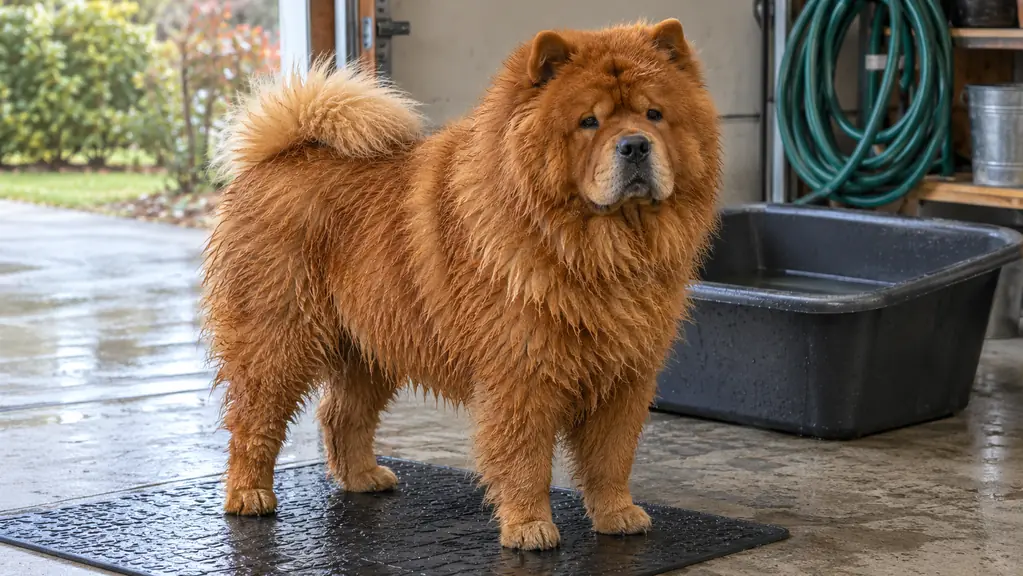
Bruno is a 7-year-old cinnamon red rough-coat Chow Chow, 64 pounds, and he has opinions. One of them is that the garage is for the car and the lawnmower, not for him getting wet. Another is that his back feet are private property. Bath day used to be a negotiation, a bath, and then three hours of towels and damp dog wandering the house while his ruff dried at its own pace.
I bought the DOPICT high velocity dog dryer in February 2026. Nine months later I have given him about seven baths with it, roughly one every six weeks. Drying went from something I planned an afternoon around to something that takes forty minutes. But the reason I keep it on the shelf is not speed. It is that his undercoat finally gets dry at the skin, and after the hot spot he had in August 2025, that is the whole ballgame.
The Quick Verdict
Loud, heavy, and worth the shelf space. It dries a double coat to the skin in about 40 minutes instead of three hours of towels, and Bruno stopped fighting it by the third bath.
Amazon Check Today's Price →The tool that turned a three-hour bath day into forty minutes
Three speeds, three nozzles, and a flexible hose long enough to reach around a 64-pound dog without moving your feet. This is the one drying his undercoat to the skin every six weeks.
Amazon Check Today's Price on Amazon →How I've Used It
Let me be plain about the setup, because most reviews of grooming tools sound like they were written by someone who has never wrestled a wet Chow. Bruno is washed in a plastic tub on the garage floor, on a rubber mat, with a hose run from the utility sink. My husband Dan holds the leash. I do the washing and the drying. There is no grooming table, no professional setup, nothing fancy. The dryer sits on the concrete beside the tub.
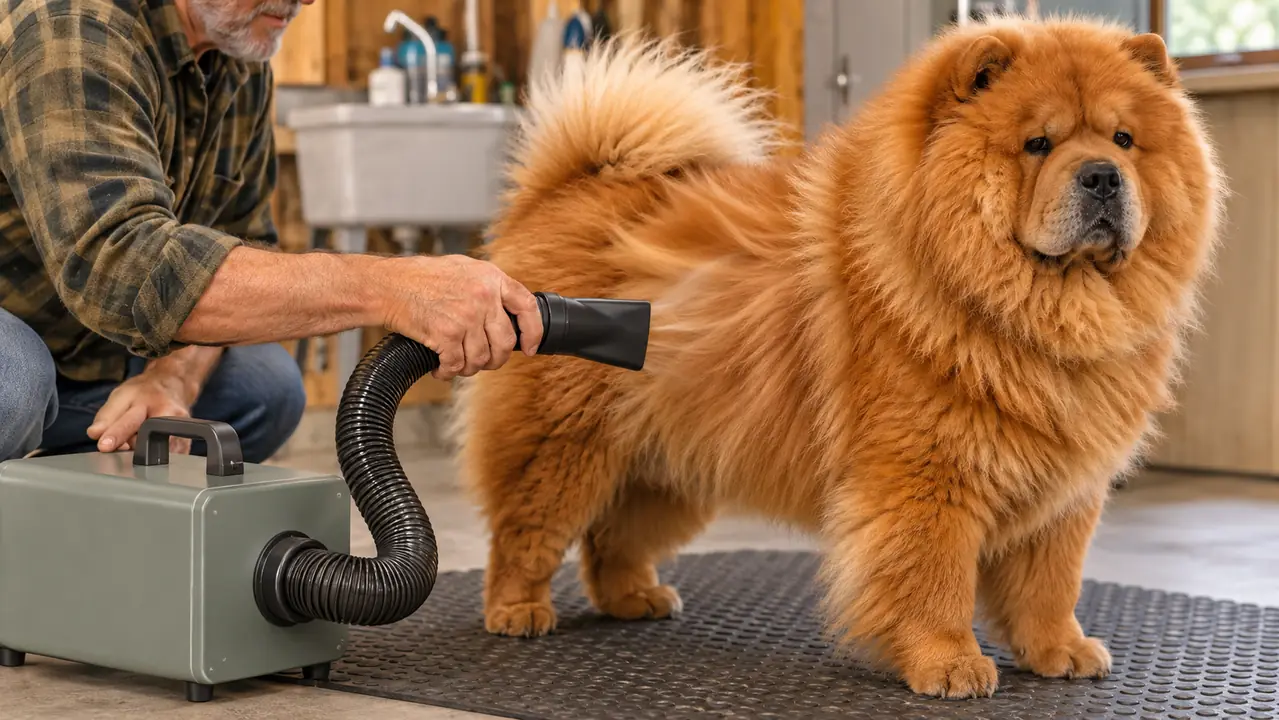
The DOPICT dryer is corded, about 9 pounds, with three speeds and three nozzles on a flexible spring hose. The temperature range on the box runs 95 to 135 degrees. I use the lowest heat setting every single time, and I start on the lowest speed. I keep the nozzle moving in slow sweeps, working a section at a time, and I never point it at his face or his ears. Those are my rules, not a manufacturer's instruction, and I would hold to them with any dryer.
Nine months and seven baths in, here is the honest shape of it. Bruno refused the thing outright on bath one. He tolerated it on bath two, mostly by pretending I was not there. By bath three he stood for it, and now he leans into it a little when I get to his ruff. That is about as much endorsement as a Chow gives anything.
The routine itself has settled into an order I do not mess with. I wash him in the tub, rinse until the water runs clear, and then Dan holds the leash while Bruno steps out onto the rubber mat and shakes twice. I start on his back legs and his pants, because those hold the most water and because he minds least when I stay behind him. Then up the back, working against the direction the coat lies, lifting it in sections so the air gets underneath instead of skating over the top. Then the chest, then the ruff, then the tail. His back feet I leave for the very end and I do them fast, because he will only give me about thirty seconds before he pulls them away. If I started with the feet I would lose him for the whole session. That ordering took me two baths to figure out and it is the single most useful thing I have learned about using this machine.
What Nine Months Actually Changed
Before this, drying was a stack of old bath towels and about three hours of air. I would towel him down, change towels, towel him again, and then let him walk around the house still faintly damp with that wet-wool smell that a Chow coat holds onto. The top of the coat would feel dry and the undercoat would still be cool and clammy against my hand. That is the part nobody warns you about with a double coat.
The August 2025 hot spot on his neck, under the ruff, is what pushed me. Dr. Nwosu treated it and it cleared up, and he has not had one since, but I spent that whole month convinced every damp patch behind his ears was the start of another. A coat that dries to the skin in forty minutes removes that particular worry from my life. That is the actual benefit. Not convenience. Not speed. Peace of mind about moisture sitting against his skin in a coat that traps it.
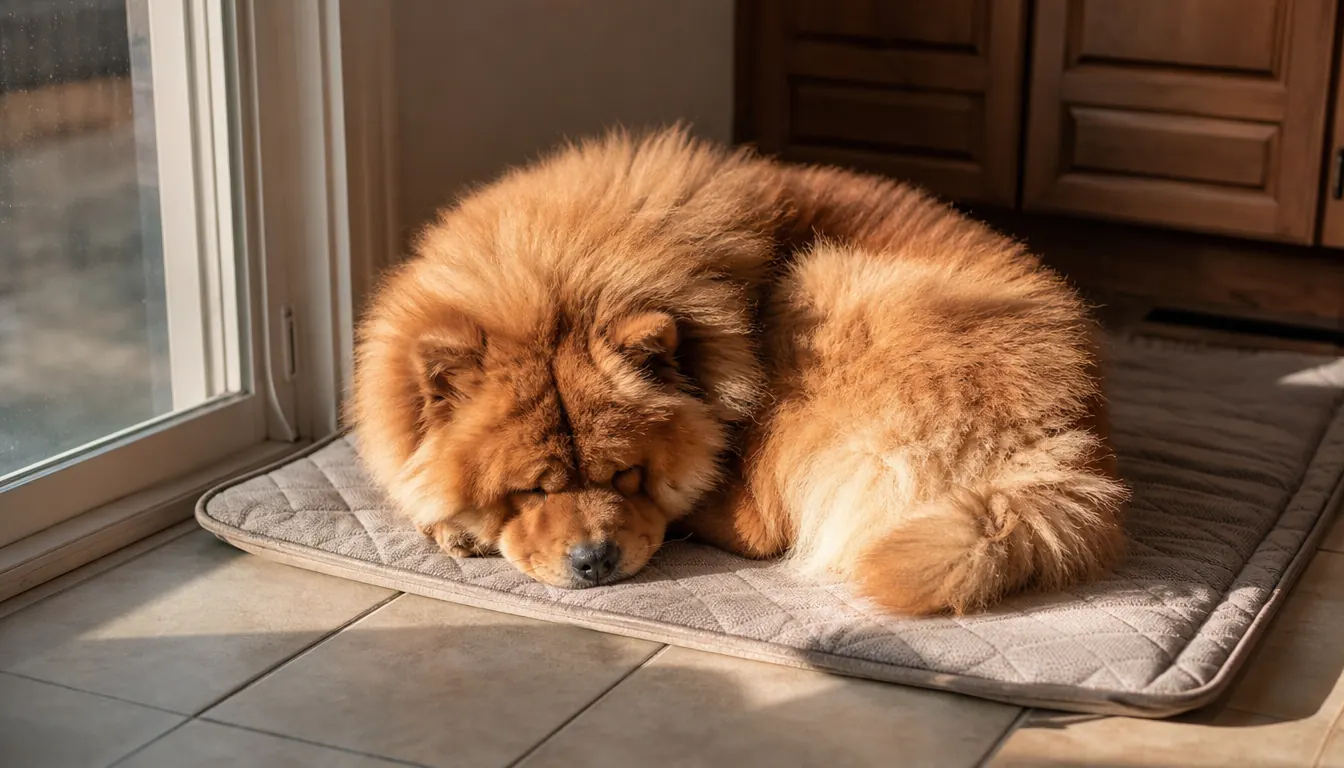
The other thing that changed is how the bath day feels. Three hours of damp dog means I am checking on him, moving him off the carpet, wiping the tile, and generally managing a situation all afternoon. Forty minutes means he is dry, he is done, and he goes and lies down on the tile in the kitchen like nothing happened. The whole job is over before I have lost my momentum.
There was one bath in particular, in July, that made the difference concrete for me. It was one of those Fort Collins days that sits in the high nineties and does not cool off in the garage. I had put it off a week already. In the old towel days I would have cancelled, because three hours of a wet dog in that heat is how you end up with a dog who cannot get cool and a person who is miserable too. This time I did the wash, moved him to the mat, and had him dry in under forty minutes with the garage door cracked. I checked his ruff the way I always do, by sliding the back of my hand down into the coat at the neck and holding it there a few seconds. Warm and dry. Two summers ago that same test would have come back cool and damp at four in the afternoon. That is a small thing to be pleased about, but I am pleased about it.
The Controls, the Noise, and the Things I Don't Love
The DOPICT dryer has three speeds and three nozzles. In practice I use two speeds: low to start, and a middle setting once he has settled. The highest setting moves a serious amount of air, up to 72 meters per second according to the listing, and it is more than I need for a dog who is already standing still. The nozzles do different jobs, and I have a favorite for getting under the ruff and along his pants, those feathered back legs. The flexible spring hose matters more than I expected, because it lets me work around his side without repositioning the machine or making him turn.
The handle is insulated, which is not a marketing line, it is what keeps your hand comfortable when you are holding the thing for forty minutes. I notice it. The casing and hose are heat resistant, and the listing says the unit has a built-in temperature control protection system that cuts in if things get too hot. I have never had it trigger, because I stay on the lowest heat, but I like knowing it is there. The machine itself measures roughly 16 inches deep, 8 wide and 12 tall, so it takes up about the footprint of a small cooler on the shelf under my utility bench. That is the whole storage question, and the answer is that it fits without a fight.
Now the part I do not love. It is loud. Not unbearable, but loud enough that I put him in the garage rather than the laundry room, partly because the concrete does not care about flying undercoat and partly because the noise has somewhere to go. It is also 9 pounds, which does not sound like much until you have held it at chest height for forty minutes. My forearm knows about it the next morning. And the dryer does not dry a dog by itself. You still have to work sections, lift the coat, and get underneath. It is faster work. It is still work.
What I Liked
- Dries a double coat down to the skin in about 40 minutes instead of three hours of towels and air
- Three speeds let me start slow with a nervous dog and stay on the lowest heat the entire time
- The flexible spring hose reaches around his side without me moving the machine or turning him
- Insulated handle and heat-resistant casing make a 40-minute job easier on the hands
- Three nozzles mean I can work the ruff and the pants properly instead of blasting everything flat
Where It Falls Short
- It is genuinely loud, and the garage is the only sensible place to use it
- At 9 pounds it gets heavy after half an hour of holding it up
- It does not replace brushing and raking, it only handles the drying
- Bruno needed three baths before he stopped objecting to it
Three hours of damp dog and a clammy undercoat became forty minutes and a dog who is dry to the skin. That is the trade, and I would make it again.
Where It Fits With the Rake and the Slicker
A dryer is a bath day tool. That is all it is. It does not touch the shedding, and a Chow still sheds. The undercoat rake does the weekly work on Sunday mornings on the patio, twenty to thirty minutes, and twice a week during the coat blows in April and May and again in October. The slicker brush does the five minutes in the evening on the ruff, behind the ears and the pants. Neither one of those replaces the other, and the dryer does not replace either of them.
What the dryer does is finish the job properly. Before, I would rake and brush a clean dog and still pull out a slightly damp comb. Now the coat is dry all the way through before I ever pick up a brush, which means the mats behind his ears get caught early instead of forming under a layer of moisture. If you only buy one thing, buy the tools you use every week. The dryer is what makes bath day not ruin the rest of the day.
This October made the point better than I could. That is a coat blow month for Bruno, and I had a Sunday morning session with the rake where the patio mat looked like a small animal had exploded on it. In previous years I would have done that rake on a dog who had been bathed a week earlier and was still carrying a little damp down deep, and the rake would drag instead of glide. It also leaves the guard coat looking ragged when it catches on damp undercoat, which is exactly the problem I had with the blade tool I stopped using at the end of 2025. This year I bathed him first, dried him properly with the DOPICT, and raked two days later. The rake moved through the coat without snagging, and the patches that used to look chewed came out even. Nine months of doing this in order has convinced me the sequence matters as much as the tools: bath, dry to the skin, then rake.
Who This Is For
This is for the person with a double-coated dog who is doing baths at home and currently owns too many towels. If you have a Chow, a Husky, a German Shepherd, an Akita, or anything with an undercoat that holds water like a sponge, you already know the problem this solves. It is also for anyone who has dealt with a hot spot or a skin issue in a damp coat and who now thinks about moisture differently than they used to.
It is for someone who can lift 9 pounds and hold it for a while, and who has a garage or a bathroom or a utility space where a loud machine will not bother the neighbors or terrify a cat. And it is for someone willing to teach a dog to accept it slowly. Bruno took three baths to come around. If you expect a stubborn dog to love a loud hose of air on the first try, you will be disappointed.
Who Should Skip It
If your dog is small and short-coated and dries in fifteen minutes with a towel, you do not need this. If you have a professional groomer doing the whole coat, and you plan to keep doing that, save your space. If your dog panics at loud noises and you are not prepared to spend several bath days on desensitizing, this will be a miserable purchase, and that is not the dryer's fault or yours.
And if you are looking at a high velocity dryer as a fix for shedding, skip it. It does not fix shedding. Nothing fixes shedding. It dries a wet coat, and it does that one job very well. Anyone promising you more than that is selling you something else.
Nine months in, seven baths, and it still comes off the shelf every time
Three speeds, three nozzles, a flexible spring hose, and a 95 to 135 degree range. The lowest heat and the lowest speed have dried a 64-pound Chow to the skin about seven times now.
Amazon Check Today's Price on Amazon →