
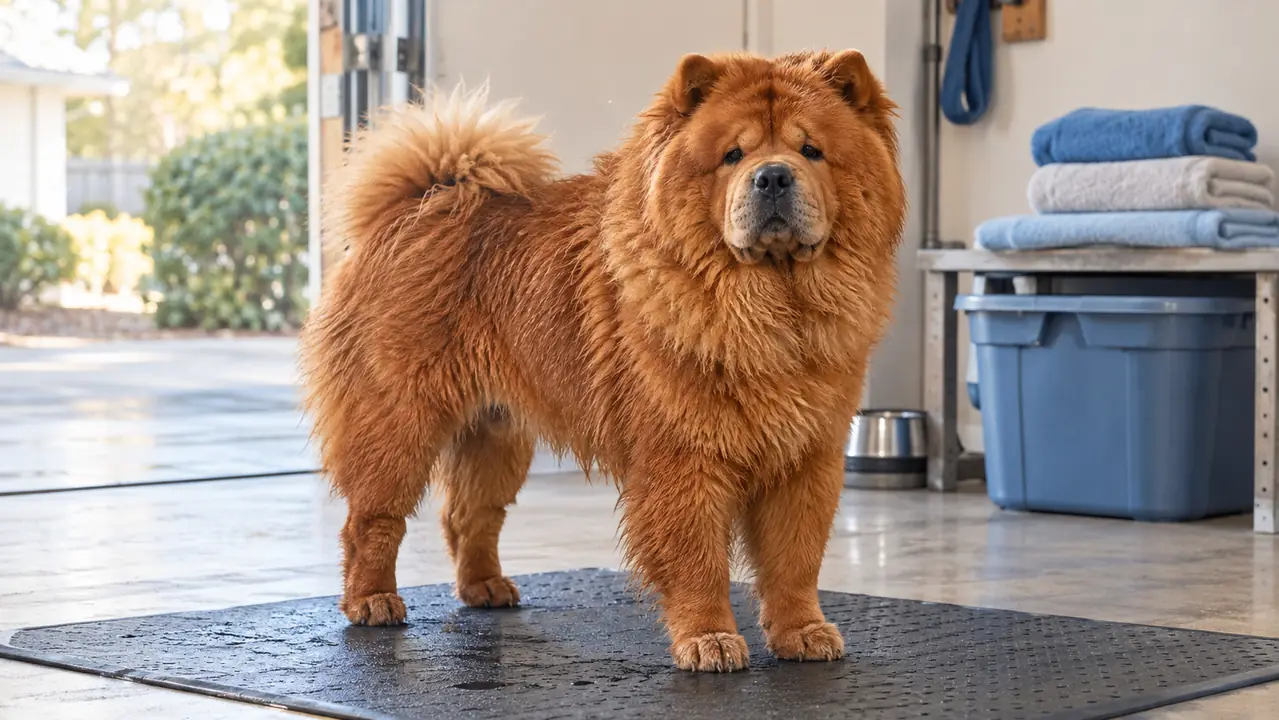
Bath day with a Chow is not really a bath. It is a bath plus three hours of standing around in a garage with a damp dog and a laundry basket of wet towels. Bruno is seven, sixty-four pounds, and carries a cinnamon red rough coat with a ruff thick enough to lose a hand in. For six years I washed him in the plastic tub on the garage floor, hosed him off from the utility sink, and dried him with a stack of old bath towels and time. I told myself that was simply what a Chow coat costs. In February 2026 I bought a DOPICT high velocity dryer. After about seven baths, the honest version is this: it did not make bath day pleasant. It made it shorter, and it made the coat dry to the skin, and those were the two things that mattered.
If your Chow stands in the tub without a wrestling match, and you have an outlet near where you wash him, the high velocity dryer wins on the one problem that actually causes trouble: a coat that stays damp against the skin for hours after the towel comes off. Towel drying wins most of the rest. It is silent. It needs no outlet. It adds nothing to your shopping list past the towels you already own. And no dog has ever been startled by a towel. The catch is that a towel does not reach under a Chow's ruff, and the undercoat against the skin is where trouble starts. My DOPICT dryer is nine months old, the towels are still in the laundry room, and I would buy it again.
| DOPICT High Velocity Dryer | Towel Drying | |
|---|---|---|
| Time to a dry coat | About 40 minutes with the nozzle moving the whole time | About three hours of towels, swapping and air drying |
| Dry to the skin under the ruff | Yes, the undercoat separates and dries through | Rarely, the base of the ruff stays cool and damp |
| Noise | Loud enough that Bruno refused it on the first bath | Silent, he stood still for it from day one |
| Power and setup | Corded, so it needs an outlet near the tub | No cord, no outlet, works in any room or in the yard |
| Cost after the first purchase | Nothing further, just the machine and its hose | Nothing further either, you already own the towels |
| Effort for the person holding the leash | Forty minutes of active work, both hands busy | Three hours of on and off work, most of it waiting |
| Chance of frightening the dog | Real for the first two baths | None that I have ever seen |
| Storage | About nine pounds on a shelf above the utility sink | A stack of towels in the laundry room |
| Best for | Chows that tolerate the tub, in a house with an outlet in the garage | Dogs that panic at loud equipment, and anyone washing indoors |
Where DOPICT Wins
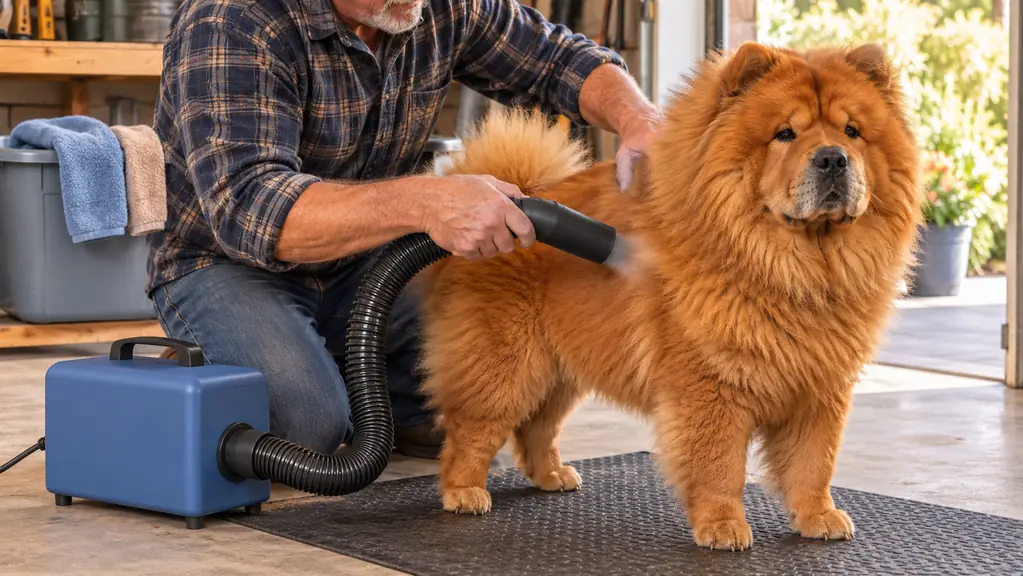
Time is the first thing. Towels and air took about three hours, and most of that was me swapping wet towels and checking a ruff that never seemed any drier. The dryer takes about forty minutes. I start on low speed, keep the nozzle moving in the direction the coat grows, and never point it at his face or his ears. The lowest heat setting, the bottom of a range that runs from 95 to 135 degrees Fahrenheit, is the only one I have ever used on him. Forty minutes of my attention against three hours of my afternoon is the whole trade, and I have not once missed the towels.
The second thing is what happens under the ruff. In August 2025 Bruno had a hot spot on his neck, under that ruff, and Dr. Nwosu treated it. I am not going to tell you a dryer prevents hot spots, because I do not know that and neither does anyone who has not run a study on it. What I will tell you is that the damp ruff was the thing I fussed over every August, and it has not been damp since February. The coat dries down to the skin. The undercoat stops lying in wet clumps against him. For a dog carrying this much coat through a Colorado summer, that is the difference between a rinse and a proper bath.
Where Towel Drying Wins
Towels win on quiet, and quiet is not a small thing. A high velocity dryer is loud. Bruno is not a nervous dog, and he still backed out of the tub on the first bath and stood at the far end of the garage for the second. A dog who panics at the vacuum cleaner will have a much harder time with this than Bruno did, and no technique on my part fixes that. Towels never made him flinch. He stood there, let me rub him down, and went back to his mat.
Towels also win on the practical side. No outlet, no cord, no machine to store, no learning curve. If you wash your dog in an upstairs bathroom, at a self-serve tub, or out in the yard, a towel is the only one of these two that comes with you. And a towel cannot overheat a dog or frighten one. It is slower, and it leaves the undercoat damp, but it is safe in a way a 3800 watt machine is not. For some households that settles the question, and I would not argue with them.
The forty minutes that replaced my three hour towel routine
DOPICT high velocity dryer: corded, three speeds, three nozzles, adjustable heat from 95 to 135 degrees Fahrenheit, about nine pounds. Nine months and seven baths in on a sixty-four pound Chow. Loud on the first bath, routine by the third.
Amazon Check Today's Price on Amazon →The Middle Path: Towel First, Then Air
Here is what I actually do, and it is the part I would tell a friend first. I towel him down hard for about five minutes after the tub, until he stops dripping. Then the dryer finishes the job. Blowing air at a soaking wet Chow is slower, it sprays water across the garage, and it wastes the thing you bought. A towel takes the standing water and the machine takes the water the towel cannot reach, which is the water sitting deep in the undercoat and at the base of the ruff.
A Chow coat holds water the way a sponge holds water, because it is two coats, not one. The soft undercoat traps the moisture and the long guard hairs keep the air off it. That is why three hours of towels and room air never quite finished the job for me. The towel could only reach the outside. The machine gets underneath, and once the undercoat is dry the guard coat follows quickly. It also means the dryer is doing work the towel was never able to do in the first place, which is a fairer way to compare the two than timing them against each other.
What the Dryer Does and What It Doesn't
The machine itself is simple, which I appreciate at my age. It is corded, with three speeds, adjustable temperature, three nozzles and a flexible spring hose. The casing is ceramic and heat resistant, and there is a built in protection that cuts the heat if it climbs too high. Mine has never tripped, because I keep it on the lowest setting. The nozzle I reach for most is the narrow one, since a Chow's ruff and pants need air pushed down into the coat rather than brushed across the top of it. It weighs about nine pounds, so I can hold it in one hand for the better part of an hour without my shoulder complaining.
What it does not do is dry a Chow in five minutes. Forty minutes is forty minutes and there is no way around that. It does not replace brushing, and if you run it over a matted coat you will spend the time blowing water around a mat instead of through it. It does not stop shedding, and it does not make a dog who hates the tub suddenly enjoy the tub. And it does not get Bruno's back feet dry without an argument, because he has never permitted anyone to do anything with his back feet, and a hose full of air is not the exception.
Forty minutes of my attention against three hours of my afternoon is the whole trade, and the coat under his ruff is dry at the end of it.
The Three Bath Learning Curve
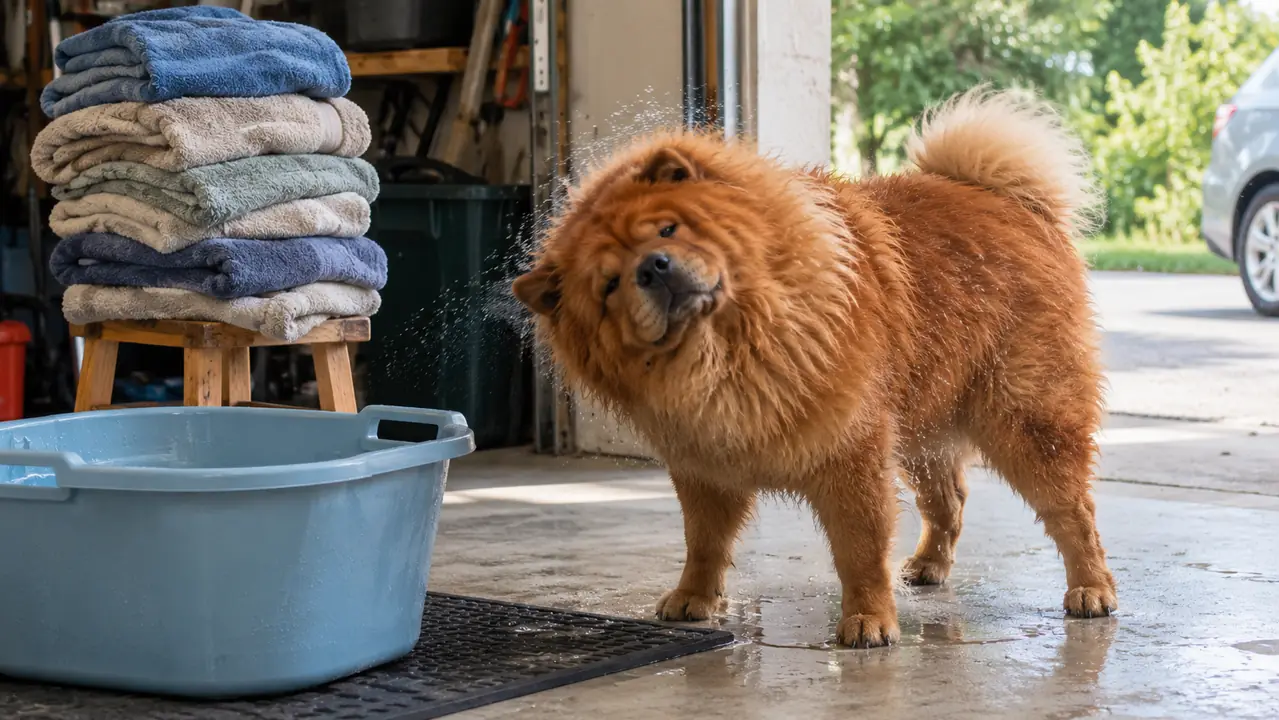
The first bath was a loss. He scrambled out of the tub, I chased him around the garage, and we finished with towels anyway. The second bath he allowed it on the lowest speed, with Dan holding the leash short and me talking nonsense at him the entire time. By the third he stood for it. Not happily. He stood. That is how a Chow agrees to anything, in my experience, and I would plan on three baths before deciding the machine was a mistake.
One note on speed. I run it low for the first five minutes and only then move to the middle setting, and I never use the top speed on him. The top speed is for the rubber mat and the wet towels, which it dries in about a minute, and for the garage floor. Start a Chow on the highest setting and you will be toweling him for another three hours while he hides behind the car.
How Bath Day Runs Now
Dan holds the leash. I wash him in the tub on the rubber mat, towel him until he stops dripping, and then he stands on the mat in the garage while I work the air through the ruff, then the pants, then the back, then the shoulders. He is done in about forty minutes. The towels get one load in the machine instead of three, and the garage smells like wet dog for an hour instead of an afternoon. The whole job, tub to dry, is under an hour now. It used to eat a Saturday morning.
His coat comes out looser, which means the rake and the slicker have an easier time of it the next morning. I still rake on Sunday and slicker every evening, and bath day does not change that. It just means I am not fighting a damp undercoat on top of everything else. The dryer is a bath day tool and nothing more. It sits on a shelf in the garage for six weeks at a stretch, and I do not miss it in between.
The Things Nobody Mentions
The loose hair goes everywhere. That is the part I was not ready for. Air pushed through a Chow's undercoat lifts the dead coat out and across the garage, and the first time I did it there was fur on the shelf, on the lawnmower, and on the wall behind him. Now I rake first and dry second, and I sweep the garage floor afterward. If you are particular about your garage, dry the dog somewhere you do not mind sweeping.
The machine is loud enough that I wear earplugs. I am sixty and I spent thirty years in a school office, so my hearing has taken enough abuse, and forty minutes of that noise is not something I want to add to it. Bruno does not love the sound either, but he has decided the tub is worse and he is right. I keep the nozzle moving and one hand on his shoulder so he knows where I am, and that settles him more than anything I say.
Space is a smaller issue than I expected. It measures about sixteen inches deep by eight wide by twelve tall and weighs nine pounds, so it lives on a shelf above the utility sink with the hose coiled around it. The three nozzles sit in a bucket next to it. That is the entire footprint. If you are picturing something the size of a shop vacuum, it is smaller than that.
Who Should Buy Which
Buy the DOPICT dryer if you wash your Chow at home, you have an outlet where you wash him, your dog tolerates the tub, and the thing that bothers you is the damp coat under the ruff that never quite dries. Buy it if you are already doing the brushing and the raking yourself and you have accepted that a Chow coat is a weekly job, not a crisis. You will use it once every six weeks and it will sit on a shelf the rest of the time. That is fine. The six weeks are the point.
Stay with towels if your dog is frightened of loud equipment, if you wash indoors or somewhere without power, or if a damp undercoat has genuinely never caused you a problem. Towels are quiet, they are already in your laundry room, and they cannot hurt a dog. They are slower than they need to be, but slower is not the same as wrong. A frightened dog does not get a better coat from a machine he hates, and no review from me should talk you out of knowing your own dog.
If the damp ruff under the coat is your problem, this is the tool that fixes it
Seven baths in on a sixty-four pound Chow. The coat dries to the skin in about forty minutes on the lowest heat, and the towels get one load instead of three.
Amazon See the DOPICT Dryer on Amazon →