
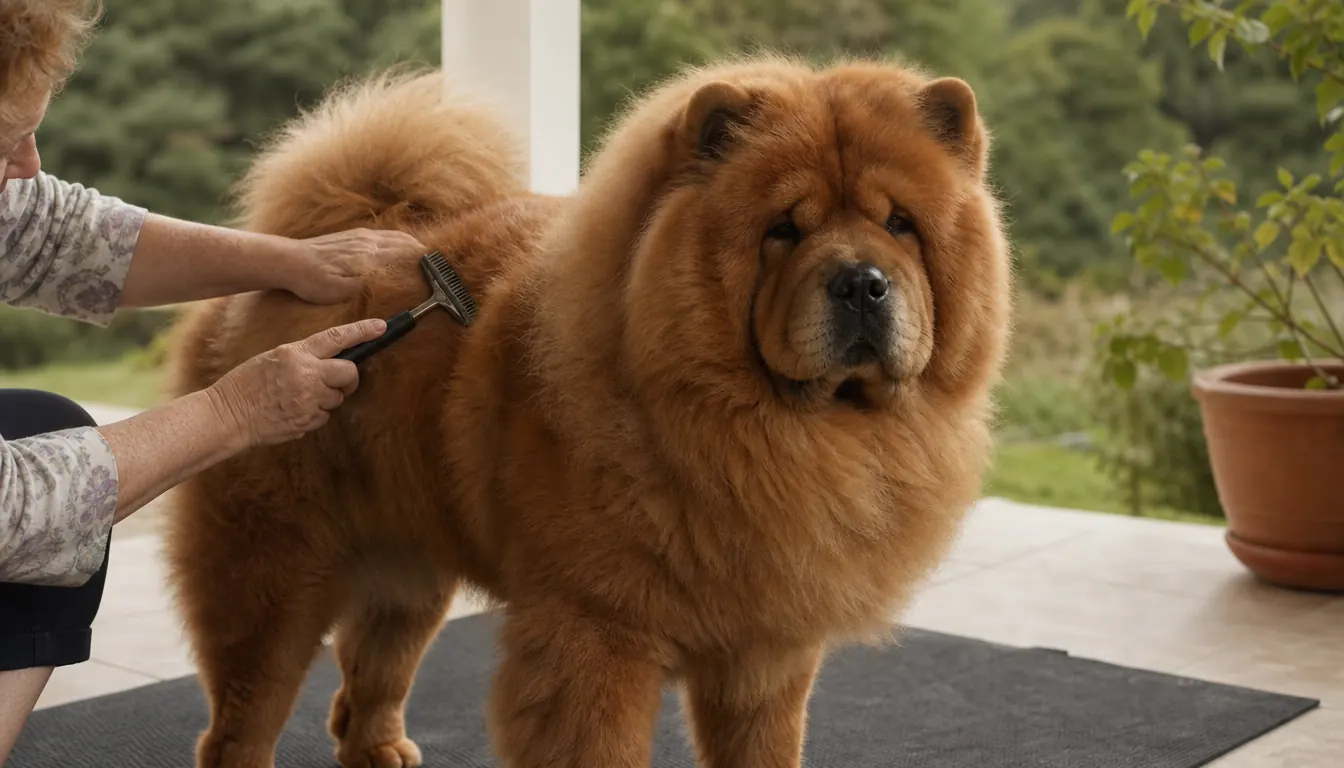
Short answer: I use both, in a fixed order, and neither one replaces the other. The Maxpower Planet undercoat rake does the weekly work on Bruno's coat. A blade-style deshedding tool pulls more loose undercoat per stroke and it does it faster, and that is the one thing it genuinely does better. If a Chow owner is buying a single tool this month, buy the rake. I say that as someone who spent a full year with a blade tool before I bought anything else, and who watched that blade leave the guard coat on Bruno's flanks looking cut and ragged by the end of 2025. The difference is not obvious in one session. It is very obvious in a year.
Bruno is my 7-year-old cinnamon red rough-coat Chow Chow. Sixty-four pounds, a blue-black tongue, a ruff you could lose a hand in, feathered pants on the back legs, and a fixed opinion about having his back feet touched. He is my first Chow and my only dog. I am not a vet and not a professional groomer, and I stopped pretending otherwise a while back. What I am is the person who has done his whole coat at home since January 2026, standing on a rubber mat on the north patio in Fort Collins, Colorado, and the person who bought the Maxpower Planet rake that same January. The listing says the tool reduces shedding by 95 percent. I cannot measure that. I can tell you exactly what changed on my kitchen tile.
| Maxpower Planet Undercoat Rake | Blade-Style Deshedding Tool | |
|---|---|---|
| How it removes hair | 17 stainless steel teeth comb through the coat and lift the loose undercoat out | A fine blade edge runs close to the skin and takes far more hair per stroke |
| Effect on the outer coat | Leaves the guard coat even, with no cut lines along the flanks | Left the outer coat looking cut and ragged by the end of a year of use |
| Mats and tangles | The 9-tooth side starts a mat at the edge and works it loose in short passes | No mat side. The blade snags on a knot and pulls |
| Speed on a full coat | 20 to 30 minutes for the whole dog on a Sunday morning | About ten minutes on the back and flanks, and you pay for it in coat condition |
| Pressure control | Oblong rubber handle with an anti-slip grip, and you set the depth of the stroke | Easy to dig in without noticing until the skin is pink |
| Comfort for the dog | Rounded tooth tips and short sessions. He stays on the mat | The blade drags. He started walking off about six minutes in |
| Cleaning | Hair lifts out of the teeth in one piece | Hair packs behind the blade and needs a comb to clear |
| Best for | Weekly work on a double coat, plus mats behind the ears and in the pants | A coat that is already mat-free and needs volume off in a hurry |
What a Chow Coat Is Actually Doing
A rough-coat Chow carries two layers, and the entire argument between these two tools comes down to which layer you are working on. The undercoat is the soft, dense layer underneath. The guard coat is the long outer layer, the part that gives Bruno his color and the part that sheds weather. A blade-style deshedding tool runs close to the skin along the boundary between the two, and it can cut into the guard coat on the way through. A rake combs the undercoat and mostly leaves the outer layer alone. That difference does not show up in one session. It shows up in month four, when one dog's coat looks even and the other dog's coat looks like somebody trimmed it in a hurry.
The other half of the problem is temperament. Bruno cooperates when he decides grooming was his own idea. He will stand on the mat with the sun on his back and the garage door open, and then something closes behind his eyes and he walks away, politely, as if he had somewhere to be. So the tool that wins in this house is the one that lets me do real work in twenty minutes and quit while he is still agreeable. That is the whole test, and it is a better test than any star rating.
There is a seasonal piece too. A Chow blows coat twice a year, and in Fort Collins that lands in April into May and again in October. During those weeks I am on the mat twice a week instead of once, and the kitchen tile tells me whether I have kept up. Outside those weeks the job is weekly and short, plus about five minutes in the evening with a slicker on the ruff, behind the ears and the pants. The slicker is the daily tool. The rake is the weekly tool. The blade tool now lives in the grooming drawer, and it comes out maybe once during a heavy blow.
Where Maxpower Planet Wins
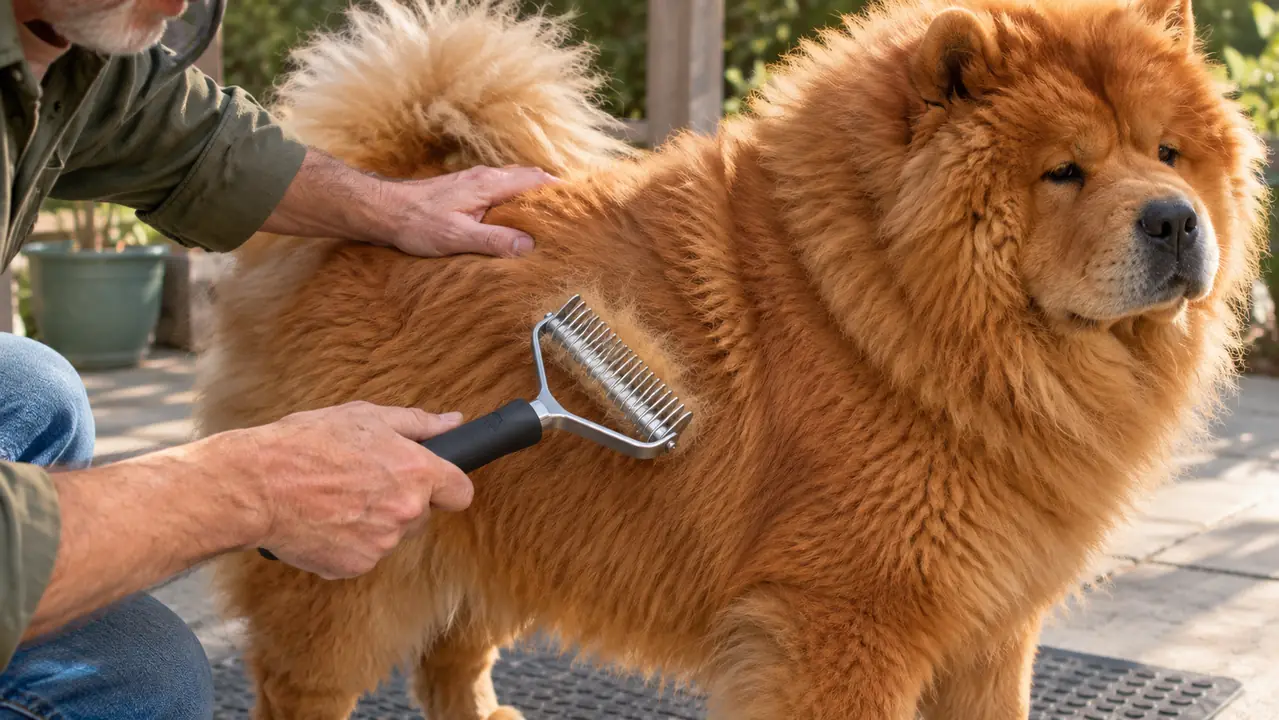
Control, first. The rake is 6.6 by 3.9 by 2 inches and weighs 4.59 ounces. It is oblong, stainless steel teeth set into a rubber handle with an anti-slip grip, and it is light enough that my wrist does not ache after half an hour, which matters more at sixty than it did at forty. The teeth are sharpened but finely rounded at the tips, so I can work close to the skin without the drag that makes a dog flinch away. Two sides do two jobs. The 9-tooth side starts a mat and worries it loose, and the 17-tooth side thins and pulls the loose undercoat out of the body. I spend maybe three minutes a session with the 9-tooth side, on the ruff and behind the ears, and the rest of the time with the 17.
Then there is what the tool leaves behind. Ten months of Sundays and the guard coat on his flanks still looks like a guard coat: even, unbroken, no cut lines along the edges. By the second week the drifts of hair on the tile were clearly fewer. By the April blow I was emptying less of Bruno into the trash each session, which is the only shedding metric I actually trust. It does not stop shedding. A Chow still sheds, and anyone who says a brush will stop it is selling you something. What the Maxpower Planet rake does is get the loose undercoat out on my schedule, on the mat, instead of on my carpet on Dan's schedule.
Where it earns its place on a Chow specifically is mats. The ruff mats at the base of the neck, and the pants mat behind the back legs on a dog that sits on tile, and both are places a blade tool has no answer for. The 9-tooth side starts at the edge of the mat and works inward in short passes, and most of them come apart in a couple of minutes without pulling. I have never raked over a hot spot or over skin that looked pink or irritated, and I would not. If the skin is angry, the tools go back in the drawer and the vet gets a call.
Where the Blade Tool Wins
Volume, and speed. I am not going to pretend otherwise to make the rake look better than it is. A blade edge takes far more undercoat off in a single pass than seventeen teeth do, and on a coat that is already clear of mats you can do the back and flanks in ten minutes flat. When I fell behind during the October blow in 2025, the blade tool was the reason I caught up before it turned into a mat problem. Nothing about the Maxpower Planet design does that one job as quickly, and I still keep it for exactly that.
It is also the tool most people own first. It is the one on the shelf at the pet store and the one in every video, which is how I ended up with mine and how I ended up using it for a full year. It worked. That was never the issue. The issue was the coat on the back half of the dog by December, thin in patches and ragged along the edges, and the fact that Bruno began leaving the mat about six minutes in. A tool that removes more hair is not the better tool if your dog stops letting you near him with it.
The one that leaves the coat you started with
Ten months of Sunday mornings on Bruno's coat. The 17-tooth side does the body, the 9-tooth side starts the mats behind the ears, and the guard coat still looks like a guard coat. It does not stop shedding. It puts the shedding on your schedule instead of your carpet's.
Amazon Check Today's Price on Amazon →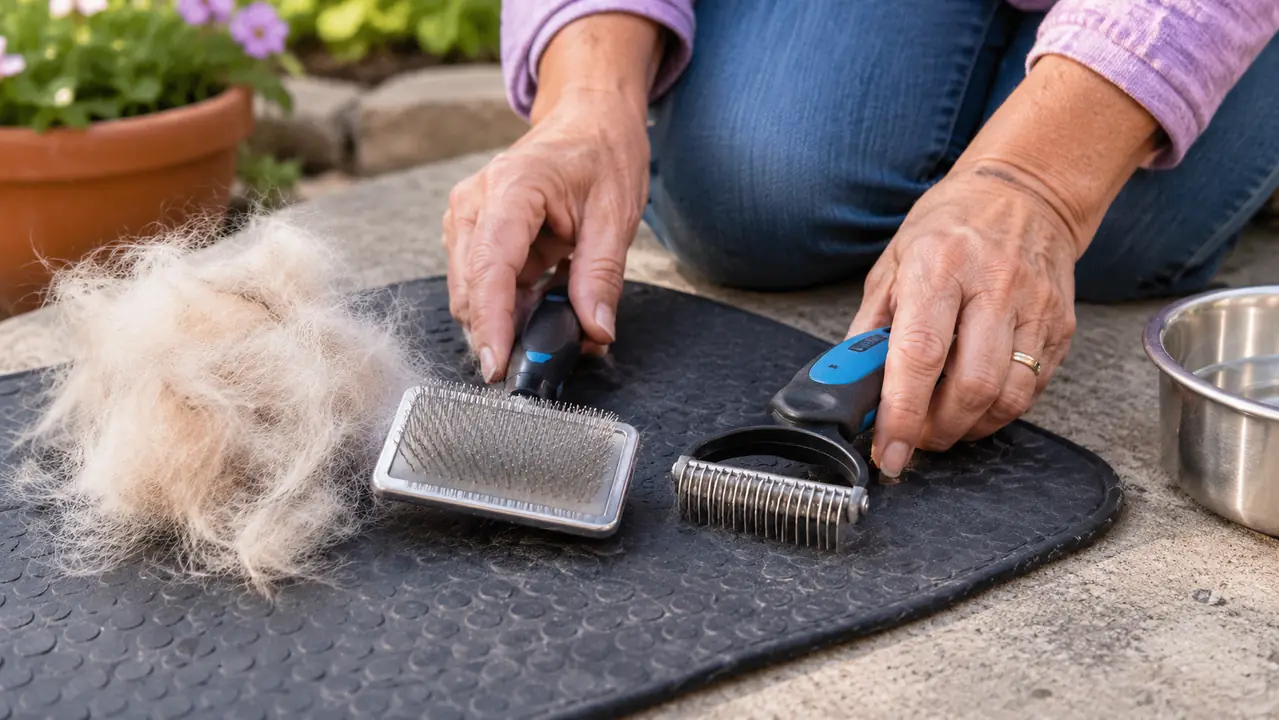
The Guard Coat Test, Ten Months In
Here is the test I would suggest to anyone standing in a pet store trying to choose. Take a photo of your dog's flank in good light, use one tool for a month, take the same photo. If the outer coat looks shorter, thinner in patches, or trimmed along the edges, that tool is cutting hair it should be leaving alone. I did this by accident, because I had photos from the summer of 2025 still on my phone, and the difference between August 2025 and February 2026 was not subtle. Same dog, same tile, a different coat.
That is the honest case for a rake over a blade on a rough-coat Chow, and it has nothing to do with how much hair lands on the mat. A blade tool gets more off today. A rake leaves you with the coat you started with, minus the undercoat that was ready to come out anyway. On a dog whose outer coat is the entire point of the breed, that is not a small difference, and it is the reason I stopped reaching for the blade on anything but a fallback.
How the Two Fit Together in My Week
Sunday morning, after breakfast, on the rubber mat on the north patio. Rake first, 17-tooth side, working with the coat from the back of the head down to the tail and then along the pants in short strokes. Twenty to thirty minutes, and then I stop, even if there is more to do, because stopping while he is still standing there is what keeps Monday easy. Twice a week during the April and May blow and again in October. The blade tool comes out perhaps once during a heavy blow, on the flanks, when the tile is telling me I am behind.
Bath day is separate. Every six weeks, in the garage, in the plastic tub with the hose from the utility sink, on a rubber mat, with Dan holding the leash. Forty minutes with the dryer afterward on the lowest heat, nozzle moving, never near his face or ears. A coat dried to the skin is the whole reason I bought a dryer, because a damp ruff under the neck is what produced the one hot spot Bruno has ever had, back in August 2025, which Dr. Nwosu treated and which has not come back since. I am not a groomer and I do not play one on the internet, but I can tell you that a dry dog is a dog with fewer problems.
Who Should Buy Which
Buy the Maxpower Planet rake if you have a double-coated dog and a weekly slot you can actually keep. Buy it if mats behind the ears or in the pants are a recurring argument in your house, because the 9-tooth side earns its place there on its own. Buy it if you have already watched a blade tool leave your dog's outer coat looking trimmed and you want to stop that. And buy it if your dog, like mine, gives you twenty good minutes and then politely leaves the room.
Reach for the blade tool if the coat in front of you is already mat-free and you need volume off in a hurry, or if you are in the middle of a coat blow and the rake alone is not keeping up with the floor. Skip it if your dog has a hot spot, thin skin, or a sparse coat, and skip it if your dog has already told you he does not care for it. Skip it too if you are hoping to stop shedding altogether. Nothing stops shedding. You are only choosing where the hair lands.
Buy the rake first. Keep the blade as a backup.
One tool for the weekly job, one side for the mats, and a coat that still looks like a Chow coat ten months in. That is the whole recommendation, from a woman who learned it the slow way with a blade tool for a year.
Amazon Check Today's Price on Amazon →