
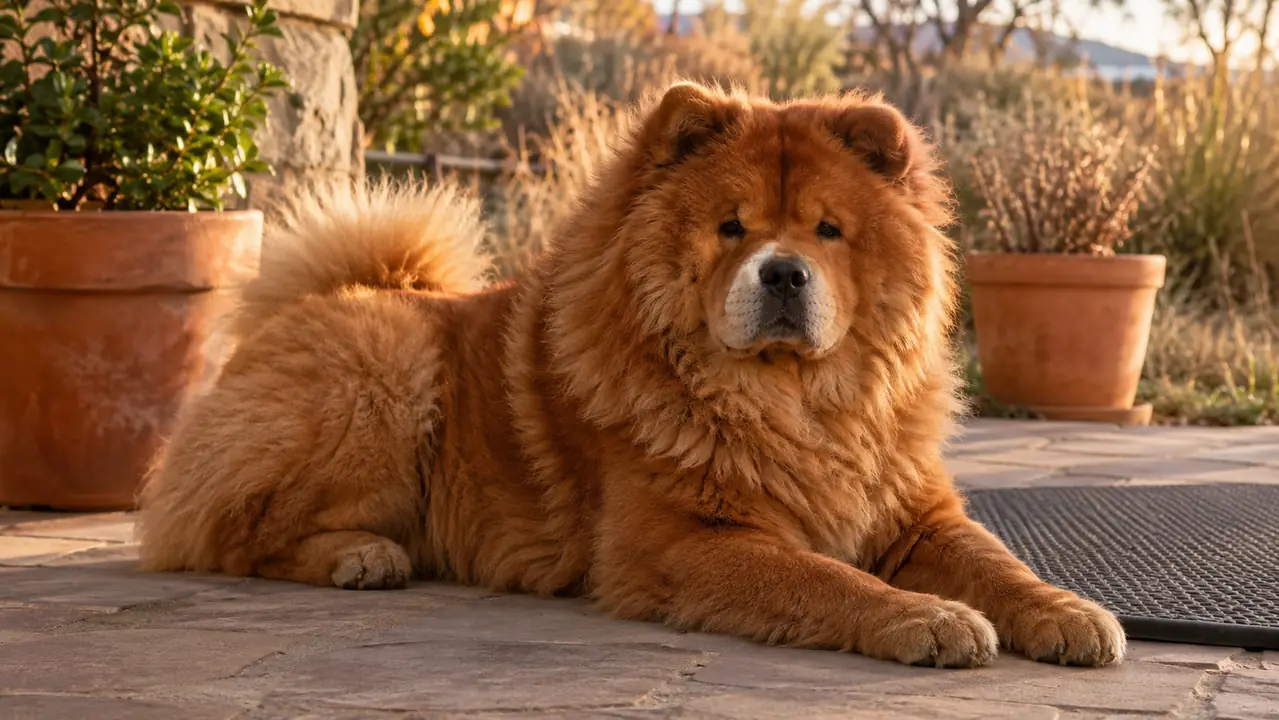
Bruno does not enjoy being brushed. He is a 64 pound rough-coat Chow Chow, seven years old and neutered, built like a hay bale with opinions. He will stand for grooming on the back patio, but he does it the way a cat stands for a bath: stiff legs, heavy sighs, eyes fixed on the fence as though he is composing a letter of complaint. What he stopped objecting to somewhere around February was the WOPQAEM self-cleaning slicker brush. Five minutes in the evening, then he walks inside and lies down. That is most of the review, honestly. The rest of it is why, and where the thing still falls short after ten months of daily use.
Before this brush I used a metal comb and a pin brush, plus a blade-style deshedding tool I stopped using at the end of 2025 because it left his guard coat looking cut and ragged. The comb was the real problem. It found every mat behind his ears and then yanked it, and Bruno would pull away and give me a look that said the whole arrangement was my idea and a bad one. The pin brush was gentler but it mostly slid over the surface of the coat without bringing anything up. I am not a vet and I am not a professional groomer. I am a retired school office administrator in Fort Collins with one dog and a shaded patio, and I do his whole coat myself now, which I have since January.
The Quick Verdict
The daily tool I reach for on a dense double coat. The release button and the angled fine pins do real work on a thick ruff, and five minutes a night kept new mats from forming behind his ears within three weeks. It will not cut an existing mat and it will not replace a rake during a coat blow.
Amazon Check Today's Price →The five minutes a night that ended the mats behind his ears
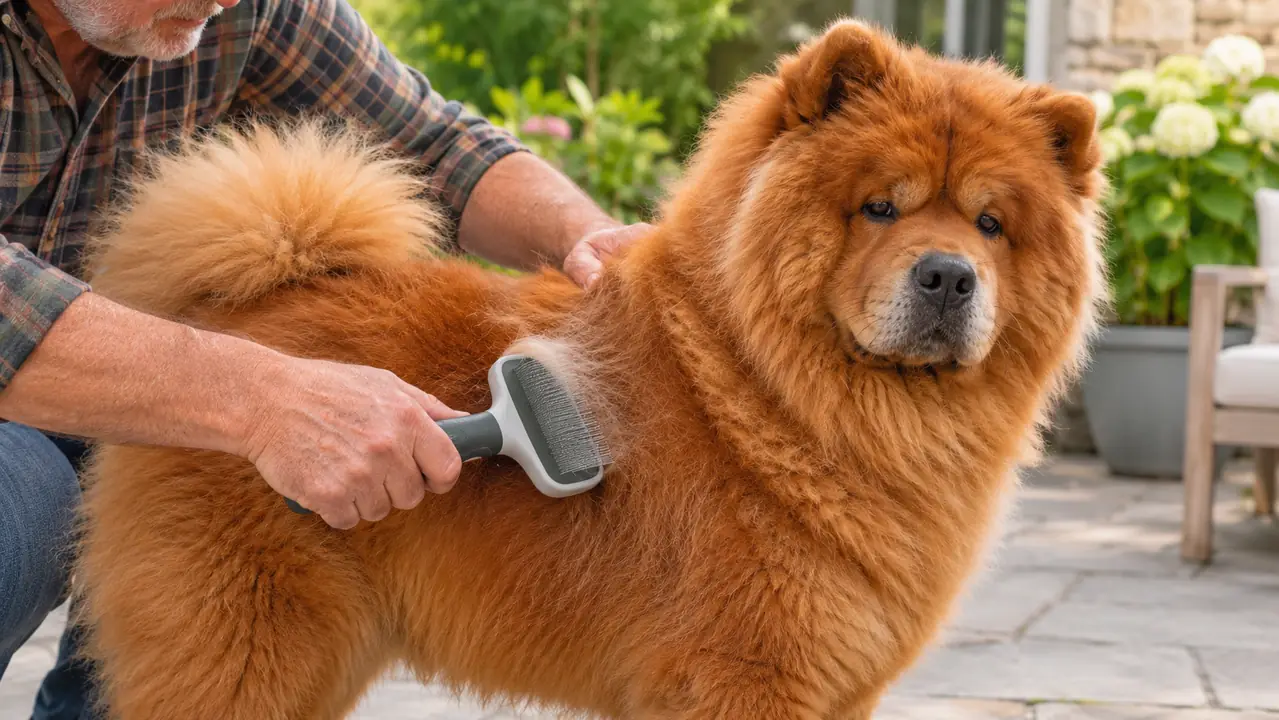
Same brush I have used since January. Press the button on the handle, the pins retract, and the hair wipes off in one pass instead of getting picked out of bristles with your fingers.
Amazon Check Today's Price on Amazon →How I've Used It
I bought the WOPQAEM slicker in January 2026, in the same order as a Maxpower Planet undercoat rake, because I had finally admitted that a comb and a pin brush were not a plan. Ten months later the routine has not changed much. Every evening, about five minutes, on the rubber mat on the back patio when the weather allows and in the garage when it does not. Ruff first, because that is the densest part and the part he minds least. Then behind the ears, which is where the mats used to start. Then the pants, the feathered back legs, in a light pass and nothing more, because he hates his back feet touched and there is no point winning that argument twice a week.
It replaced the pin brush. That is the cleanest way to say it. The pin brush glided over the top layer and made the coat look tidy for about a day. This one actually gets down into the undercoat, and the difference shows up in what comes off the dog rather than in how the dog looks afterward. I still own the comb. I use it maybe once a week to check behind the ears and under the ruff, and it comes back clean most of the time now, which was not true a year ago.
How I hold the thing matters more than I expected. The head is oblong, listed at 7.09 by 3.94 by 2.56 inches, and the whole brush is 5.29 ounces. That is light enough that my wrist is not complaining after five minutes, which was not the case with the heavier pin brush I had before. I work two or three inches of coat at a time, short strokes in the direction the hair grows, wrist loose. No grooming table here, just the mat and Bruno standing in the shade, and the light weight is a real part of why he stands for it.
One more thing about the routine, because it took me a while to learn it: stop while he is still bored rather than while he is still patient. Five minutes and done beats fifteen minutes and a dog who hides behind the hydrangeas the next evening. The brush makes that easy because it clears as fast as it fills. If a session is going badly, I quit and pick it up tomorrow. Ten months of short, uneventful evenings has done more for his coat than any single long session ever did.
What the Release Button Actually Does
You press the release button on the handle when you are done and the stainless steel pins retract into the head, so the hair that was wrapped around them comes off in one piece. On a short-coated dog that would be a convenience. On a Chow with a dense undercoat it is the difference between grooming and doing janitorial work. A brush like this fills up in a handful of strokes. With the pin brush I was stopping every thirty seconds to drag the hair out of the bristles with my fingers, and the hair never came out cleanly anyway. With this one I press the button, wipe the pad of hair into the waste bin, and keep going.
The handle is plastic with a TPR rubber grip, and after ten months of near-daily use the button still retracts the pins fully and the grip has not gone slick or gummy. That sounds like a low bar. It is not, for a tool that lives on a patio mat and gets pressed a dozen times in a session. I have had kitchen gadgets give up sooner.
What it does not do is sharpen itself or clear a truly packed head. Every so often hair works down to the base of the pins and the button alone will not shift it. Thirty seconds with the metal comb fixes it. That is the entire maintenance routine, and I do it maybe every third week.
The Angled Pins and a Chow Ruff
The listing says the fine-wire stainless steel bristles are angled at 135 degrees to reach into a thick double coat and catch loose undercoat fur, and on Bruno that is more or less what happens. His ruff is the hardest part of him to brush, a thick collar of coat around the neck and chest that a flat brush just skates across. Short strokes with the angled pins lift the loose stuff out of it instead of packing it down. The first few sessions produced a surprising amount of hair for a dog I had been brushing regularly for six years.
The angle earns its keep on the pants too, the long feathered hair on the back legs. That coat hangs straight down and tangles at the bottom edge, and a straight pin brush would pass over it without doing much. A light pass from underneath, working outward, keeps the feather from roping up. That is the one place I have to be careful about pressure, because the skin there is thin and he is touchy about it.
On pressure: let the pins do the work and do not lean on the tool. I check skin by parting the coat with my fingers after a pass. If it looks pink or he flinches, I stop for the day. In August 2025 he had one hot spot on his neck under the ruff, treated by Dr. Nwosu, and it has not come back. I do not brush over irritated skin with anything, this brush included. If your dog has a raw or weeping spot, that is a vet call, not a grooming decision.
The listing also says the brush suits small, medium and large dogs as well as indoor cats, and I believe it, because the head is a modest oblong rather than a wide paddle. For me that means the tool is nimble around the ears and under the jaw where a broad brush gets clumsy. The tradeoff is coverage, which I get to further down.
Ten Months In: What Changed and What Didn't
By the third week there were no new mats behind his ears. That was the whole reason I bought it, so I will lead with that. Before, I would find a small tight mat behind one ear or the other every couple of weeks, and the comb would find it the hard way. Now the evening pass catches the loose hair before it ever gets the chance to felt. In ten months I have found two small ones, both after a wet week, and both came out with the rake's nine-tooth side without drama.
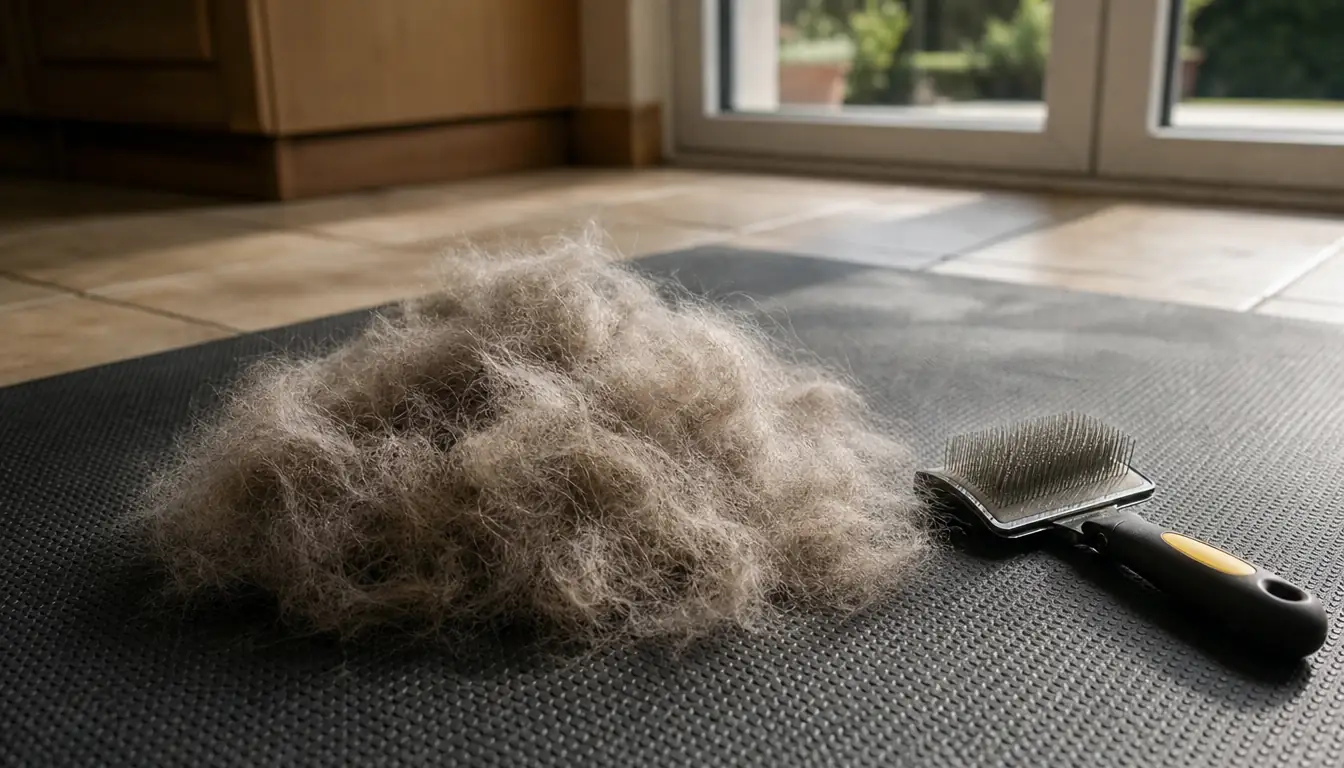
The tumbleweeds on the kitchen tile are fewer. I noticed that in the second week and I still notice it in November. Some of that is the rake, which I use on Sunday mornings for twenty to thirty minutes, and I am not going to pretend the slicker gets all the credit. The honest division is that the rake pulls the volume out of the undercoat once a week and the slicker keeps the edges and the trouble spots clear the other six days.
What did not change: he still sheds. A Chow sheds. Anyone who tells you a brush stops it is selling you something. The coat blow hits in April and May and again in October, and during those weeks I rake twice a week instead of once and the slicker still goes every evening. The brush manages the shedding. It does not end it, and I would be lying if I said otherwise after ten months of sweeping.
The other thing that improved is the bath. He gets one about every six weeks in a plastic tub in the garage, with Dan holding the leash, and I dry him with a DOPICT high velocity dryer I bought in February. That dryer only works if the coat is separated down to the skin, and the slicker does that separation better than the comb ever did. Seven baths in, drying takes about forty minutes instead of the three hours of towels and air it used to take, and I do not think I get that number without the coat being opened up first.
There is a smaller change I did not expect. Bruno lets me near his ears now without the ears going flat against his head first. Six years of a comb hitting tangles will teach a dog that hands near the ears mean pain. Ten months of hands near the ears meaning nothing much seems to have taught him the opposite. That is not a feature on the box. It is the reason I keep the brush where I can reach it.
Where It Falls Short
It will not cut a mat. If your dog already has a felted lump behind an ear or under the ruff, the pins skate right over it and you will get nowhere. That is a rake job with the nine-tooth side, or a groomer, or in a bad case scissors and a vet visit. A slicker brush is a prevention tool. It keeps the mats from forming. It is not a rescue tool, and treating it like one will just make your dog hate the sight of it.
It does not replace the rake for volume. The 17-tooth side of the Maxpower Planet pulls out undercoat in quantities that the slicker simply does not, and during a coat blow that difference is the whole game. If you buy only one tool for a Chow, buy the rake. If you buy two, this is the second one, and it is the one you will actually touch every day.
The head is a modest strip, so a 64 pound dog is a full five minute pass rather than a two minute one. On a smaller dog you would be done faster. On Bruno I do the ruff, the ears and the pants on weeknights and save the flanks and the rear for the Sunday session with the rake. If you want a brush that covers a whole big dog in one sweep, this is not sized for that.
And the pins are fine wire. They are meant to be. That means they will not survive a dog who chews, and it means pressing hard does nothing good. Put it up on a shelf when you are done, and let the tool do the work.
How It Fits With Everything Else
The routine here is simple and has not changed since spring. Slicker every evening, about five minutes. Rake on Sunday morning, twenty to thirty minutes, twice a week during the coat blows. Dryer on bath day only, lowest heat, low speed to start, nozzle always moving, never near his face or ears. In summer the cooling mat lives on the kitchen tile by the patio door, and glucosamine chews go with breakfast every morning, which is Dr. Nwosu's suggestion after the hip X-rays in February and not a grooming product at all. None of these replace each other. That is the point.
If you are weighing this against a pin brush specifically, the short version is that they do different jobs and the slicker is the one that reaches the undercoat. I wrote a longer comparison of the two if you want the details, but the practical answer after ten months is that my pin brush is in a drawer and this one is on the patio.
What I Liked
- The release button retracts the stainless steel pins and the collected hair wipes off in one piece, which matters on a coat that fills a brush in seconds
- The 135-degree angled fine pins get under a dense ruff and lift loose undercoat instead of packing it down
- Light at 5.29 ounces, so five minutes a night does not wreck my wrist the way the heavier pin brush did
- No new mats behind his ears by the third week of daily use, and only two in the ten months since
- Button and rubber grip still working after near-daily use on a patio mat since January
Where It Falls Short
- Will not cut or remove an existing mat, which is a rake or groomer job
- Does not pull the volume a rake does during the April and October coat blows
- Fine wire pins will not survive a dog who chews, so it has to be put away
- The oblong head covers a modest strip, so a big dog is a full five minute pass
By the third week there were no new mats behind his ears. He still sheds, and he always will. He just does not felt anymore.
Who This Is For
This is for the owner of a dense double-coated dog who will actually do five minutes in the evening, most evenings. That is the whole requirement. If brushing is already part of your day, the WOPQAEM slicker makes that five minutes count for more than a pin brush does, and the release button means you spend the time on the dog instead of on the tool. Chow owners especially, because the ruff and the pants are exactly the places these angled pins handle well, and because mats behind the ears start small and get ugly fast.
It is also for anyone who has quietly given up on a comb because their dog flinches every time it touches a tangle. Bruno still does not love grooming. But he stopped bracing for it, and that happened in the first month, and it is worth more to me than a tidier coat.
Who Should Skip It
Skip it if your dog is already matted. A slicker will not fix that, and working it over a felted coat is uncomfortable for the dog and futile for you. Get the mats out with a rake or a groomer first, then come back to a daily tool. Skip it if you want one brush to do everything, because it will not replace a rake on a heavy-coated breed and I would rather you bought the rake first. And skip it if your dog chews grooming tools, unless you are going to store it out of reach every single time.
If your dog has a short, flat coat that never mats, this is more tool than you need. A basic pin brush does the same job on that coat, and you will not miss the button. I am not a vet and not a professional groomer, and nothing here is medical advice. If your dog has skin trouble, a hot spot or a lump you are not sure about, that is a call to your own vet before it is a grooming question.
Ten months in, it is still the brush I pick up every night
Five minutes on the ruff, behind the ears and the pants. Press the button, wipe the hair off, done. If your dog's coat is dense and the mats keep starting in the same two places, this is the tool that stopped it here.
Amazon Check Today's Price on Amazon →