
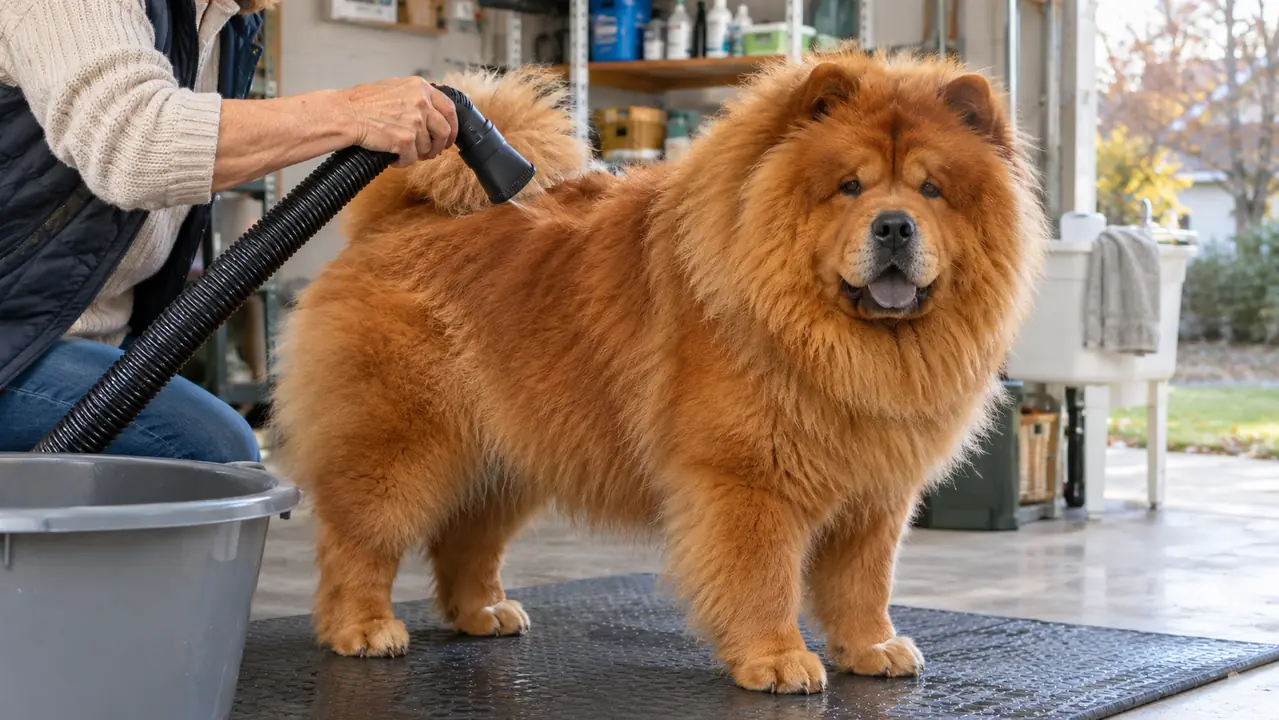
The first time I aimed the DOPICT high velocity dryer at Bruno, he left. Not dramatically. He simply turned, walked out of the garage, and stood in the driveway looking at me like I had betrayed something between us. He is a 7 year old cinnamon red rough-coat Chow Chow, 64 pounds, and he has never been a dog who argues. He just removes himself from situations he has decided against.
We are nine months and about seven baths past that afternoon. He stands for it now. Not happily, exactly, but he stands. And my drying time went from roughly three hours of towels and air on a February evening to about 40 minutes. That is the whole case for this machine in one sentence, and it is a good case. But there are things about it I did not expect and things I would want to know if I were reading this before I bought one, so here they are, in the order they actually happened.
The Quick Verdict
A loud, fast, genuinely effective tool for getting a double coat dry to the skin, with a learning curve for the dog and a noise level you should plan around.
Amazon Check Today's Price →If your Chow's ruff is still damp at bedtime, this is the tool that ends that
Same machine I have used since February 2026. Corded, three speeds, three nozzles, adjustable heat up to 135 F.
Amazon Check Today's Price on Amazon →What I Actually Bought, and Why
I am not a groomer and I am not a vet. I am a retired school office clerk in Fort Collins with a one-story ranch house, a tile kitchen, and a Chow who hates having his back feet touched. A professional did Bruno twice a year through the end of 2025. When I took the whole coat over in January 2026, I started with a rake and a slicker brush and thought that was the whole job.
It was not. Brushing handles loose hair. It does nothing about a bath. In August 2025 he had a hot spot on his neck, under the ruff, and Dr. Nwosu treated it. One hot spot, one time, and I have thought about it every bath since. A damp ruff sitting against the skin for hours on a February evening is exactly the setup you do not want. That is the reason the DOPICT dryer came into this house. Not convenience. The damp underlayer.
The listing on this one is not shy. 5.2 HP, 3800 watts, a maximum of 72 meters per second wind speed, temperature between 95 and 135 F, three speeds, three nozzles, a flexible spring hose, and a 9.22 pound body that measures about 16 by 8 by 12 inches. Ceramic casing, heat resistant, with a temperature protection system that cuts in if it runs too hot. Some of that is marketing language. Some of it is the reason it works.
Before February I did what most people do, which is a stack of old bath towels and about three hours of air drying in a cool garage. It works, technically. The dog ends up dry. But a February evening in Fort Collins puts that garage in the forties, and a wet Chow in a cold garage takes forever to come dry, and the whole time he stands there shivering with the flat patience of an animal who has decided I am no longer to be trusted with baths. I tried a second towel. I tried rubbing him down and then walking him around the block to warm him up. I tried letting him lie on the laundry room tile with the furnace running. None of it reaches the underlayer. That is what pushed me to the machine.
Worth saying plainly: the dryer is the third tool in a chain, not the first. I bought the undercoat rake and the slicker brush in January, and the dryer in February, in that order, and I would do it in that order again. The slicker is a five minute job in the evening. The rake is a Sunday morning job on the patio. The dryer shows up on bath day and then goes back on its shelf. If you buy the dryer first and skip the brushing, you will be blowing loose undercoat around your garage and calling it grooming.
How I've Used It, Start to Finish
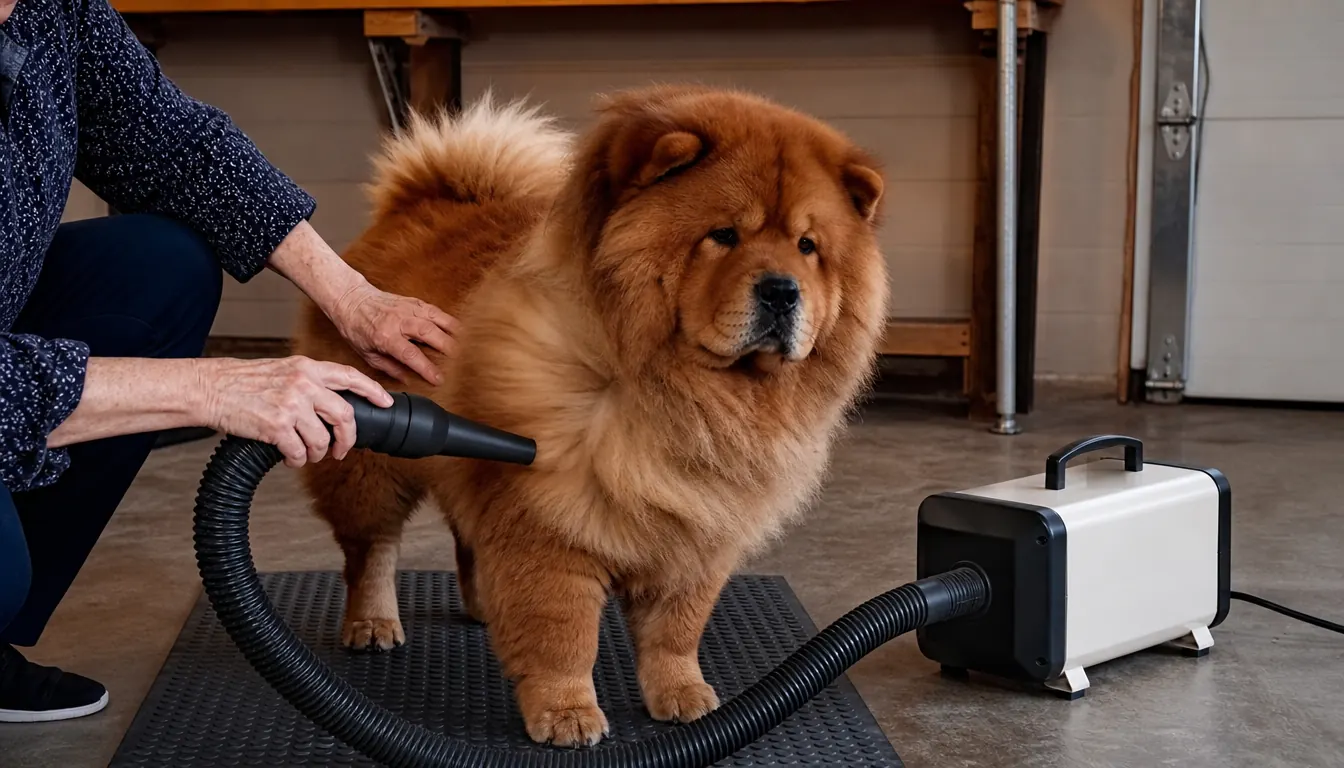
Bath day happens in the garage. Bruno gets washed in a plastic tub on the garage floor, hose fed from the utility sink, on a rubber mat. Dan holds the leash. I do the washing and all the drying. That has not changed since January.
What changed is what happens after the rinse. I towel him once, briskly, mostly to stop the drip. Then the dryer comes on. I start on the lowest speed and the lowest heat, and I keep the nozzle moving the entire time. Never held still in one spot. Never pointed at his face. Never pointed into an ear. I work the back first, then the pants on his back legs, then the sides, and the ruff last, because the ruff is the part that matters and I want to be patient when I get to it.
Here is the actual order, in case you are about to do this for the first time and want to skip my mistakes. Towel once, hard, until he stops dripping. Then the dryer on low speed and the lowest heat, held maybe a foot off the coat, moving in slow passes along the grain of the hair. Back first, shoulders toward the tail. Then the pants, and for the pants I lift the leg a little and get underneath, because that is where the water hides. Then the sides and the chest. The ruff last, and the ruff takes the longest. I part it with my hand and dry in layers, working from the skin out, and I do not stop until my fingers come up dry at the base. The whole thing runs about forty minutes with a break in the middle where he stands in the open garage doorway and looks at the driveway.
About 40 minutes, and he is dry to the skin. I check with my fingers in three places, the base of the ruff, the middle of the back, and under the pants on the right rear leg. If any of those three come up cool and dry, we are done. In nine months of doing this, we have not had a damp ruff at bedtime once.
When it is over there is a fine layer of hair on everything in the garage. Not clumps. Dust. The dryer pushes the loose undercoat off the dog and it settles on the tub, the mat, the shelving, the front of the utility sink. I keep a shop vac by the door and run it over the mat before I roll it up. Five minutes, and it is the price of the forty minute dry. If you plan to do this indoors, in a bathroom or a laundry room, plan on that hair landing on the walls and staying there a while.
What Nobody Tells You About High Velocity Dryers
Here is the part that would have saved me a bad first attempt. High velocity does not mean high heat. The machine can reach 135 F and there is no reason on this earth to run it there on a dog. I have never taken it off the lowest heat setting. Air moving at that speed does the drying. Heat just makes the outer coat feel dry while the undercoat stays wet, which is the exact failure I bought the thing to avoid.
Second thing: this is a loud tool. Not unbearable, but loud enough that I hear it in my teeth. Bruno is a dog who pants hard once it passes about 80 degrees and who is unbothered by thunder, and even he needed three baths to settle. Bath one he refused entirely. Bath two he tolerated about ten minutes and then leaned against my leg in protest. Bath three he stood. By bath five he yawned in the middle of it, which for a Chow is a fairly warm review.
Nobody tells you the machine is the easy part and the dog is the work. My first try was five minutes after the bath with the dryer already running, which produced the driveway incident. What I should have done is what I did before bath two. I brought the dryer out with the dog dry, set it on the mat, ran it on low across the room for about thirty seconds, shut it off, and handed him a piece of chicken. Then I did it again the next day. Four days of that with no water involved. By bath two he knew the sound, and he still did not love it, but he did not leave. If your Chow is the type to walk away, spend a week on that, not five minutes.
Third: it does not replace brushing. Not even a little. If I dry a coat that has not been raked, I get a dry coat full of loose undercoat that is now airborne. The drying works because the brushing already happened. This is a bath day tool. That is all it is.
Fourth, and this one caught me: your hands are part of the process. There is no sensor telling you the coat is done, so the whole judgment lives in your fingertips and your eye. I spend the entire forty minutes with one hand in the fur and the other on the nozzle, feeling for the cool patch that means water is still sitting there. It is more physical than I expected. My first three baths, I finished with a cramp in my right hand and I had no idea why.
High velocity does not mean high heat. Air moving at that speed does the drying. I have never once taken this machine off its lowest heat setting.
Performance Over Nine Months
Seven baths. One roughly every six weeks, which is more than some Chow owners bathe and less than others. I have used all three nozzles. The wide one for the body, the narrow one for the pants and the ruff, and the third one mostly sits in the bin. The flexible hose has held up. Nothing has cracked, nothing has loosened, and the casing stays cool enough to pick up with a bare hand after 40 minutes of running, which the handle design helps with.
The temperature protection system has never kicked in on me, because I run it cool. I mention that honestly rather than as a feature endorsement. If you are the kind of person who maxes every dial, you will meet that system and I cannot tell you how it behaves.
Some baths are easier than others. The April one landed in the middle of his spring coat blow and the dryer pulled so much loose undercoat off him that I stopped twice to sweep the mat. That was the fastest forty minutes of the seven, because there was less coat left to hold water. The July bath was the opposite. It was 94 outside and the garage was hot, he was already flat on the tile before we started, and I ran the dryer on low partly just to move air over him rather than to dry anything. He stood for it because it was cooler than the air in the room. February and March were the hardest, because the garage was cold and he wanted it over with. Those are the baths where the forty minutes feels long for both of us.
The coat itself looks better than it did when I was air drying. Not shinier, exactly, but smoother and less clumped. The pants on his back legs lie flat instead of holding little curls of damp. And the ruff, which used to stay slightly heavy for a day after a bath, comes out full. I notice it. Dan notices it, and Dan does not notice coats.
The Parts I Don't Love
The noise. I said it once and I will say it again, because it is the single thing that would make me hesitate if I were recommending this to a friend with a nervous dog. If your Chow flinches at the vacuum, budget two or three bath days for adjustment and do not expect bath one to go well.
I also do not love that the machine gives me nothing to tell me the coat is finished. No dial reads the fur, no light goes off when the underlayer is dry. It is my fingers or nothing, which is why I check the same three places every single time and why I probably run it two minutes longer than strictly needed. Someone with a better feel for a coat would finish sooner. I finish on the safe side, and the safe side is more noise for a dog who has already been patient.
The weight in one hand. Nine pounds does not sound like much until you hold it at chest height for 40 minutes with your arm out. My shoulder aches the next day. I have started switching hands halfway through, which Bruno tolerates and my shoulder appreciates.
And the cord. It is corded, which is the tradeoff for 3800 watts, and it means I am tethered to the garage outlet. Fine in my garage. Less fine if you bathe a dog outdoors far from an outlet.
What I Liked
- Cuts drying from about three hours to about 40 minutes on a full double coat
- Gets the undercoat dry to the skin, which is the whole point for a ruff like a Chow's
- Three speeds and adjustable heat from 95 to 135 F, so you can run it low and slow
- Three nozzles cover body, pants and ruff without buying anything extra
- Casing and handle stay cool enough to hold after a long session
- Flexible hose reaches the back legs without me crouching over him
Where It Falls Short
- Loud enough that a nervous dog will need two or three baths to accept it
- 9.22 pounds held at arm's length for 40 minutes is real work on the shoulder
- Corded only, so you need an outlet near your washing spot
- Does nothing for a coat that has not been brushed first
- Easy to misuse. High heat will dry the top coat and leave the undercoat wet
Who This Is For
If you have a double-coated dog with a ruff and pants, and you bathe at home, and your current method involves a stack of towels and an evening of waiting, this changes your life in a small specific way. It is also for anyone who has dealt with a hot spot or a damp underlayer and does not want a repeat. Drying to the skin is not a luxury. For a Chow in a humid month, it is closer to basic care.
It is also for someone who already brushes properly. If you have the daily slicker and the weekly rake routine going, the DOPICT dryer is the third piece. If you do not, buy the rake first. The dryer is the last step in a chain and it cannot carry the chain on its own.
And it is for the owner who will actually read the dial. The people I know who got the most out of a dryer like this are the ones who never moved it off the low heat setting and treated the whole thing as an air tool, not an oven. If you want a machine to do the thinking, this is not that machine. It is three speeds, a heat control and a hose, and the judgment stays with you.
One more group, and I mean this one. It is for the person whose dog is fine but whose own back is not. Bending over a tub to rub a wet Chow with a towel for the better part of an hour is not nothing at sixty. Standing upright with a hose in my hand for forty minutes is easier on me than crouching with a towel ever was. I did not expect that to be part of the case for it, but it is.
Who Should Skip It
If your dog is genuinely frightened of loud equipment, this is not the tool to train that out of. A dryer that stresses a dog into a bad bath experience sets your coat work back months, and no amount of saved time is worth that. I would also skip it if you have a short-coated dog, or if you bathe at a groomer, or if you have shoulder trouble and no one to hand it off to.
And skip it if you think it replaces brushing. It does not. Nothing replaces brushing a Chow. The rake and the slicker do the actual work of the coat. The dryer finishes the job.
One more honest note. This is not a quiet machine and it is not a shortcut around the work. It is a loud, powerful, slightly heavy tool that does one job extremely well, and that job happens every six weeks in my garage. Bruno would tell you he could live without it. His neck, which has not had a hot spot since August 2025, disagrees.
Seven baths in, I would buy it again. Here is the one I use.
Corded, 5.2 HP, three speeds, three nozzles, 95 to 135 F. Run it on the lowest heat and keep the nozzle moving.
Amazon Check Today's Price on Amazon →