
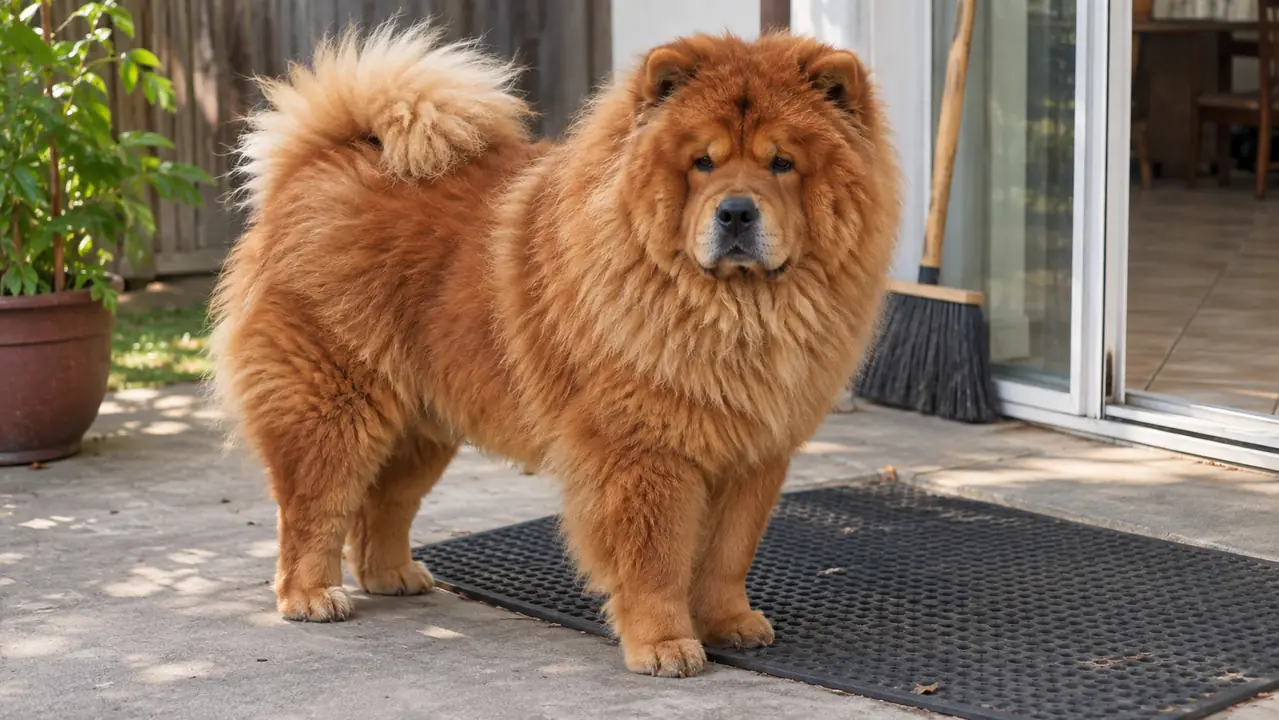
Bruno turned seven in March, and he has never been what you would call a light shedder. Chow Chows have two coats and the underneath one is the size of a second dog. But the first week of May is different. I swept the kitchen tile by the patio door on a Sunday morning, and by Tuesday there were three fresh drifts of red-gold undercoat along the baseboard, each one roughly the size of a small bird. By Thursday the drifts had joined up. If you live with a Chow, you know exactly what I am describing, and you know it is not a crisis. It is a coat doing what a coat does. What finally made a dent in it for me was a Maxpower Planet undercoat rake, used on a schedule, and here is the five-step routine I have settled into.
For six years before that I fought the coat with a metal comb and a pin brush, and mostly I lost. A pin brush parts the topcoat and skates right over the felted undercoat underneath it. The comb finds the mats, but it does not lift the loose hair out, so the loose hair stays where it sits until it packs down into another mat. What actually works is getting a tool down to the skin and pulling the dead undercoat out instead of pushing it around. For me that tool turned out to be an undercoat rake. The one I have used since January 2026 is the Maxpower Planet double-sided rake, and ten months of Sunday mornings later I would buy it again tomorrow.
One tool, two sides, and a coat that stops packing down into felt
The Maxpower Planet undercoat rake has a 9-tooth side for mats and a 17-tooth side for thinning and deshedding, with stainless steel teeth and a rubber, anti-slip handle. It is the weekly half of this routine. The slicker does the other half, and I will get to that.
Amazon Check Today's Price on Amazon →Step 1: Learn what each side of the rake does before it touches your dog
The Maxpower Planet rake is double-sided, and the two sides are not interchangeable. The 9-tooth side is the mat and tangle side. The teeth are set wider apart, and it is built for the hard felted lumps that form behind the ears and under the ruff. The 17-tooth side is the thinning and deshedding side. That is the one that does the real weekly work, lifting dead undercoat out of a coat that is otherwise healthy.
I did this backwards for the first month. I used the 17-tooth side on everything because it moved faster and made a bigger pile, and then I spent twenty minutes on a mat behind his left ear with the wrong side of the tool and made the mat worse. The 9-tooth side took that mat apart in about four minutes. The teeth on both sides are sharpened, but the points are finely rounded, and that matters more than it sounds like it should. The skin under a Chow's ruff is thin, and Bruno will tell you immediately if a tool is scratching instead of combing.
The way to decide which side you need is with your fingers, not your eyes. Run your hand flat along the coat from the shoulder back toward the tail. Where the coat moves like cloth, you want the 17-tooth side. Where it feels like felt, or where your fingers stop on a lump, you want the 9-tooth side. That is the whole decision, and you make it every few minutes for the first several weeks, until you can feel it without thinking about it.
Step 2: Put the rake on a schedule, and double it when the coat blows
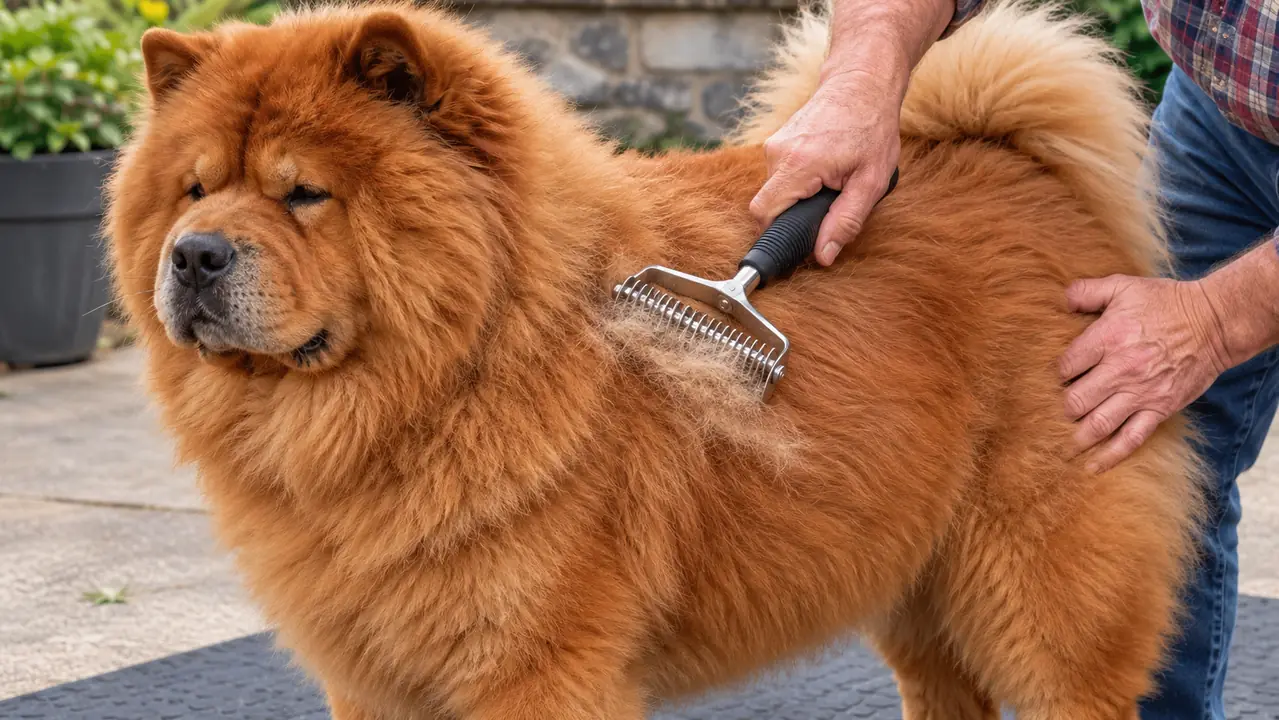
The Maxpower Planet rake is a weekly tool in this house. Sunday morning, back patio, rubber mat, twenty to thirty minutes, weather permitting. That is ten months of Sundays now. During the coat blows, which for Bruno means April into May and again for a stretch in October, it goes to twice a week. Not longer sessions. More sessions. A Chow will tolerate twenty minutes of almost anything and he will not tolerate forty minutes of anything, and if you push past that you have taught him that grooming is a thing to be endured, which is the opposite of what you want.
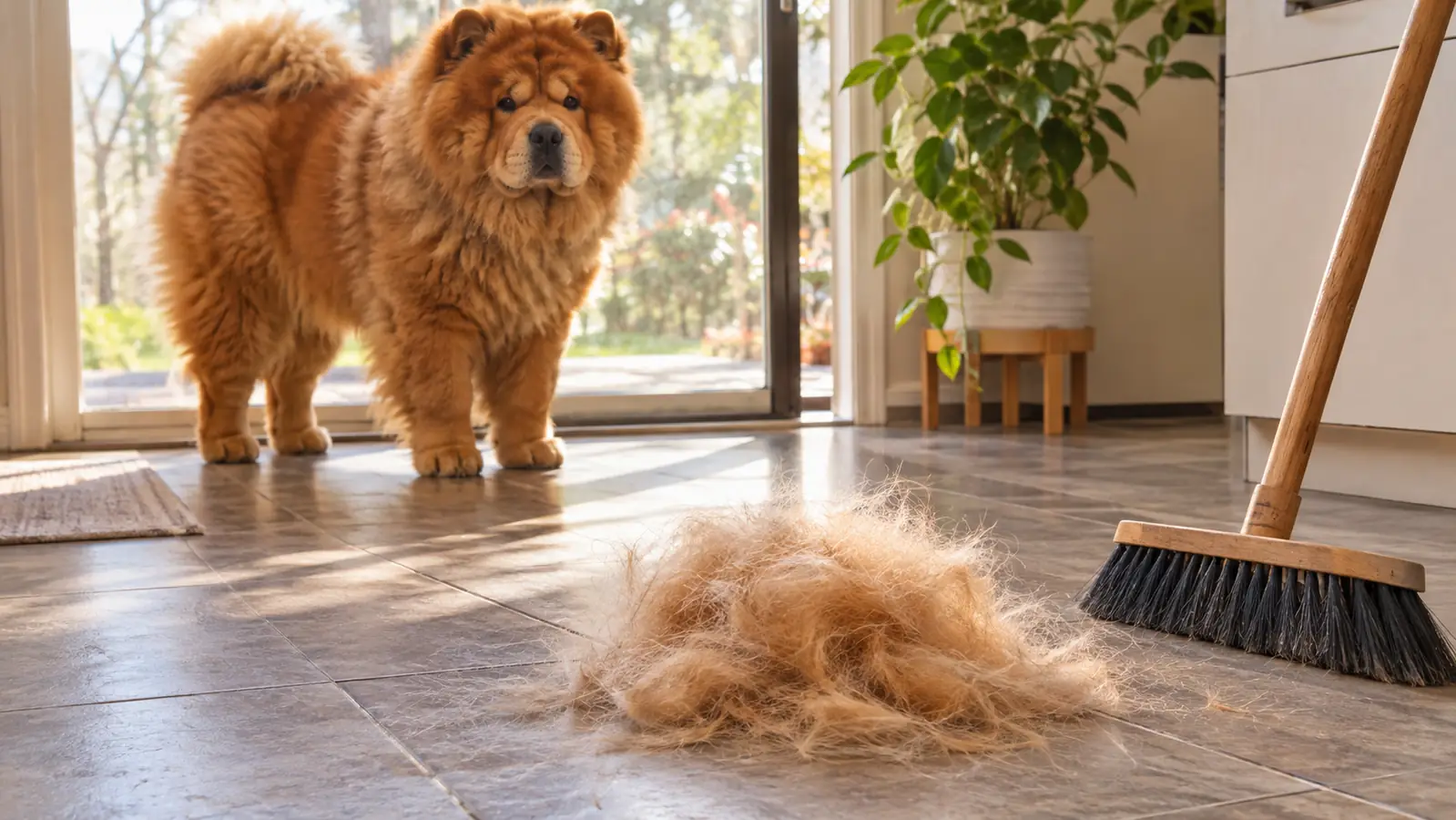
What changed, and changed quickly, was the floor. By the second week of that first January the drifts on the tile were obviously fewer. By spring I was sweeping twice a week instead of every morning. Understand what that means, and what it does not. It does not mean the rake stops shedding. A Chow sheds. Nothing in a pet store stops a double coat from cycling. What the rake does is take the loose undercoat out on a mat on the patio instead of letting it migrate into the corners of the kitchen and into the fibers of the living room carpet.
The other reason for a schedule is that Bruno cooperates with things he believes were his own idea. A surprise grooming session is an insult. A session that happens every Sunday morning after breakfast, in the same spot, ending the same way, becomes part of the week and he stops arguing about it. If you only get the rake out when the coat is already out of control, you are asking a stubborn dog to sit through a long unpleasant session, and you will both hate it.
Step 3: Work in sections, and go with the coat, not against it
Start at the back half and work forward, because the back of a Chow is the part he cares least about. Bruno will let me rake his shoulder and his flank all morning. The pants, the feathered back legs, are a negotiation, and his back feet are off limits entirely. So the order is: back and flanks first while he is still relaxed, then the ruff, then behind the ears, then the pants if he is still standing for it. On a bad day the pants wait for the next session, and that is fine.
Lay the rake flat against the skin and draw it in short strokes in the direction the coat grows, about the length of your hand each time. Not long sweeping pulls, and no digging. The teeth should be under the topcoat and against the skin, and you should be able to feel where they are with the flat of your free hand, which stays on the dog the whole time. Lift the tool out at the end of each stroke and pull the collected hair off it into a paper bag. Short strokes and a clean tool. Long strokes let the teeth load up and then they drag, and dragging is what makes a dog walk away from you.
Work in lines, the way you would mow a lawn, moving over an inch or two and then going back over it. You will be surprised how much comes out of a patch you thought was already done. When the tool starts coming back clean, that patch is finished and you move on. Do not go over the same square foot fifteen times trying to get the last hair. There is always more hair. The goal is progress, not a bald dog.
Step 4: Know when to stop, and know what to hand off to the slicker
Two things end a raking session early. The first is a mat that will not break up with the 9-tooth side worked from the outside in. Do not saw at it. Work the edge of the mat loose a little at a time, and if it still will not come, leave it and come back in a few days. The second is skin. In August 2025 Bruno had a hot spot on his neck under the ruff, and our vet, Dr. Nwosu, treated it and told me plainly what I already suspected, which is that a damp undercoat plus a thick ruff is a bad combination. I have not raked over irritated skin since. If the skin is pink, angry, or broken, the tools go away and the vet gets a call.
The rake is not the daily tool. The daily tool is a slicker brush, about five minutes in the evening, on the ruff, behind the ears, and the pants. I bought a self-cleaning slicker in the same January order as the rake. You press the button on the handle, the pins retract, and the hair wipes off in one piece instead of you picking it out of the pins with your fingers. Within about three weeks of daily five-minute sessions there were no new mats behind his ears, which had been a constant before that.
The two tools do different jobs, and neither replaces the other. The slicker keeps the surface and the trouble spots from felting on a day-to-day basis. The rake pulls dead undercoat out of the depth of the coat once a week. If you only use the slicker, the undercoat keeps packing down and you find out about it in April. If you only use the rake, the mats behind the ears get a week's head start. Ten minutes a week plus five minutes a day is the entire routine.
By the second week the drifts on the tile were noticeably smaller. By spring I was sweeping twice a week instead of every morning. The coat did not stop shedding. It stopped ending up in the corners of my kitchen.
Step 5: Use bath day to finish what the rake started
A bath is where a Chow coat either gets clean or gets ruined, and the difference is drying. I wash Bruno in the garage, in a plastic tub on the floor, on a rubber mat, with a hose from the utility sink. Dan holds the leash. It is not dignified for anybody involved. The part that matters comes after: getting the coat dry all the way down to the skin. A damp undercoat next to warm skin is exactly the setup for the kind of trouble we had in August 2025.
I bought a high velocity dryer in February 2026, and it has changed bath day more than anything else I have bought. It is corded, it has three speeds, three nozzles, a flexible hose, it weighs about nine pounds, and the heat setting runs from 95 to 135 degrees Fahrenheit. I use the lowest heat, start on the lowest speed, keep the nozzle moving constantly, and never point it at his face or his ears. It is loud. Bruno refused it outright on the first bath, tolerated it on the second, and stood for it by the third. Drying takes about forty minutes now, against roughly three hours of towels and air drying before.
The order on bath day is rake first, then bath, then dry, then back to the slicker for the next few days. Raking a clean coat is wasted effort, and raking a wet coat is worse than wasted. Get the loose undercoat out while it is dry and loose, wash what is left, and dry it properly. Then the daily slicker sessions keep it from felting back up before the next Sunday.
What Else Helps
The rake is the center of the routine, but it is not the only thing in it. In May 2026 I bought a cooling mat in the 36 by 24 inch size, and it lived on the kitchen tile by the patio door from June through September. It is nylon cool-touch fabric with soft filling, no gel, no water, and nothing to plug in. Bruno claimed it on the first hot day. At 64 pounds he fits on it curled up, and his back legs hang off when he stretches out. It is not a substitute for shade, for water, or for skipping a midday walk when it is 95 degrees, and it does nothing at all for his coat. It just means he is not panting on the tile while I am sweeping it.
Weight and hips matter to grooming more than people expect. In February 2026 Dr. Nwosu found mild hip dysplasia on X-rays, after I noticed Bruno was slow getting up off the floor in the mornings. She recommended a joint supplement and keeping his weight steady, and he has been on a glucosamine, chondroitin and MSM soft chew since, two chews a day with his breakfast, which is the label amount for his weight. About eight weeks in he was rising more easily. It is not a cure. His hips are still his hips, and any supplement decision is one to make with your own vet. But a dog who is comfortable standing is a dog who stands still for twenty minutes on a Sunday, and that is a grooming fact as much as a medical one.
Beyond that: the vet tech trims his nails at checkups, which is one job I am happy to hand off. He gets brushed on the patio, not on the carpet, because hair on a rubber mat is a two-minute cleanup and hair in a carpet is a permanent feature. I keep a paper bag next to the mat for what comes off the rake. And the last thing, which is not a product and not a technique: keep the routine boring. Same day, same spot, same order, same ending. A Chow who knows what is coming is a Chow who stands there and lets you finish.
The weekly half of a Chow coat routine, ten months and counting
Two sides, stainless steel teeth, a rubber anti-slip handle, and about six and a half inches long, so it fits a hand without a wrestling match. It will not stop a Chow from shedding. It will move the shedding to the patio.
Amazon Check Today's Price on Amazon →