
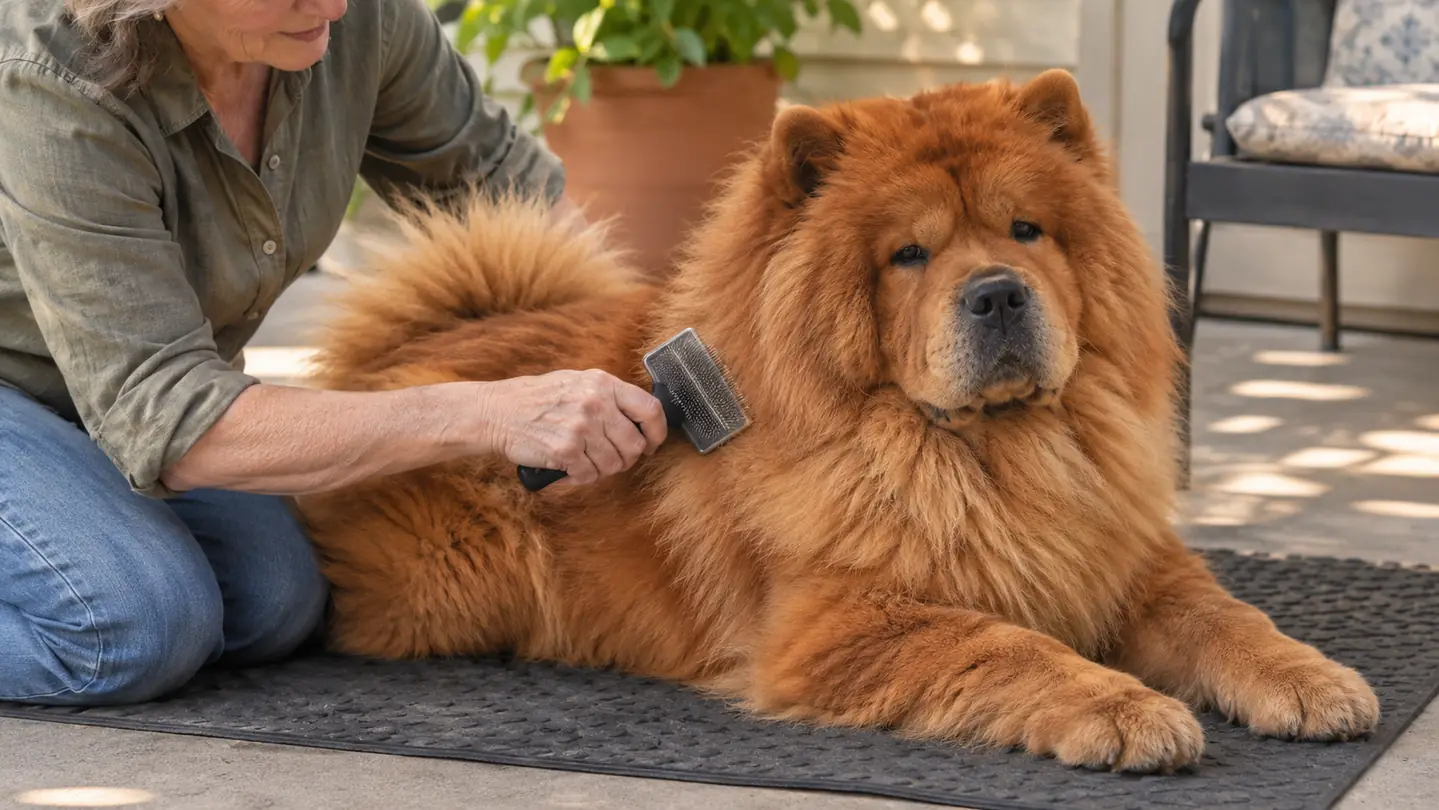
Bruno is seven years old, sixty-four pounds, and shaped like a sofa with opinions. He is a cinnamon red rough-coat Chow Chow, which means one dog carrying two coats worth of hair and a firm belief that grooming should be somebody else's idea. He has never once asked to be brushed. So when I say a slicker brush works on Chow fluff, I mean it earns its place in a house where the dog cooperates only after he has decided the whole thing was his plan.
I bought the WOPQAEM self-cleaning slicker brush in January 2026, in the same order as an undercoat rake. Ten months later it sits on the shelf by the patio door and comes out for five minutes a night, most nights of the year. Not because I am disciplined. Because it is the only coat tool Bruno will stand still for without a wrestle, and the pins do the arguing instead of me. I am not a vet and not a professional groomer. I am a retired woman in Fort Collins with a husband, one Chow, and a rubber mat on the back patio, and this is what ten months of daily use has taught me.
The five minutes Bruno will actually stand for
Daily work on the ruff, behind the ears and the pants is what keeps mats from forming between rake sessions. Press the release button and the hair wipes off the pins in one pass, so the whole job is five minutes, not twenty.
Amazon Check Today's Price on Amazon →The pins sit at 135 degrees, so they get under the ruff instead of skating over it
A Chow ruff is not one layer. It is a dense outer coat sitting on a woolly undercoat, and a straight pin brush mostly glides across the top of it and looks busy while doing nothing. This brush uses fine-wire stainless pins angled at 135 degrees, which lets them dip below the surface and lift the loose stuff out. I work in short strokes, ruff first, then the shoulders, and I let the pins do the work instead of pressing down hard.
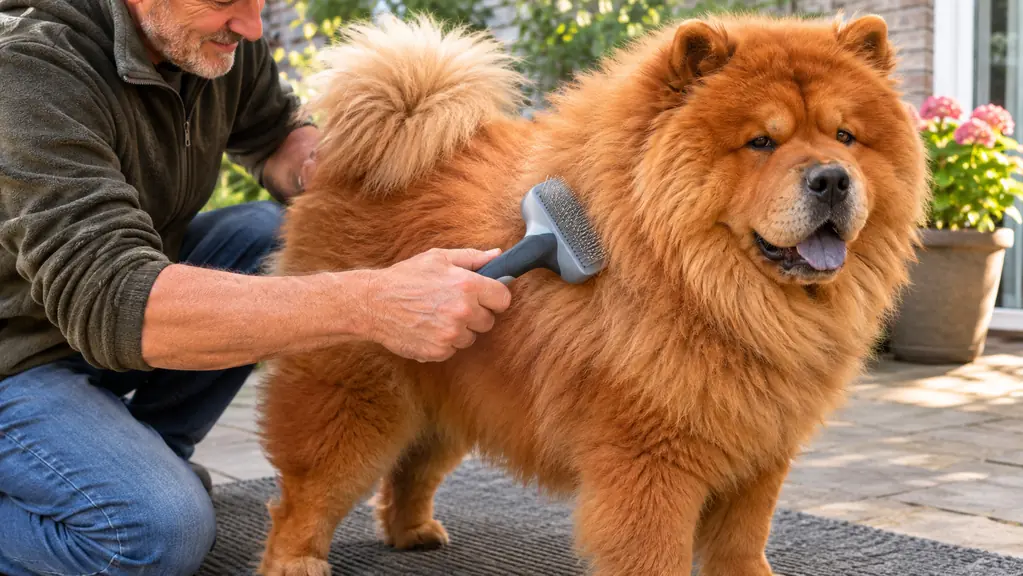
Five minutes a night beats one long Sunday session
Chows have a patience budget and it is not large. Bruno will give me about ten minutes before he stands up, yawns at me, and walks to the door. Five minutes daily stays inside that budget, so we never reach the point where he associates the brush with being held hostage. Within three weeks of starting, there were no new mats behind his ears. That was the first time in seven years I could say that out loud.
Press one button and the hair comes off the pins
The self-cleaning part is not a novelty, it is the reason I keep using the thing. When I finish, I press the release button on the handle and the flexible stainless pins retract, and the pad of hair wipes off in a single pass over the trash. With my old pin brush I spent as long picking hair out of the bristles as I did brushing the dog. A tool that is annoying to clean is a tool that stays on the shelf.
It reaches behind the ears, where the mats actually start
On Bruno, trouble always begins in the same three places: behind the ears, under the ruff at the neck, and the pants on the back legs. Behind the ears is the worst, because the hair there is fine and dense and mats form quietly inside a week. The pins on this brush are thin enough to get into that hollow without scraping him. I do thirty seconds a side, every night, and that alone has kept the mat problem from coming back since January.
The pants on his back legs come out without a fight
Bruno hates having his back feet touched, and he has hated it since he was nine weeks old. So I do not touch the feet. I brush the feathered hair on the back of the legs from above, in short downward strokes, and the flexible pins follow the shape of the leg instead of yanking at it. It takes about two minutes a side. Two minutes, no growling, no back feet involved. In this house, that counts as cooperation.
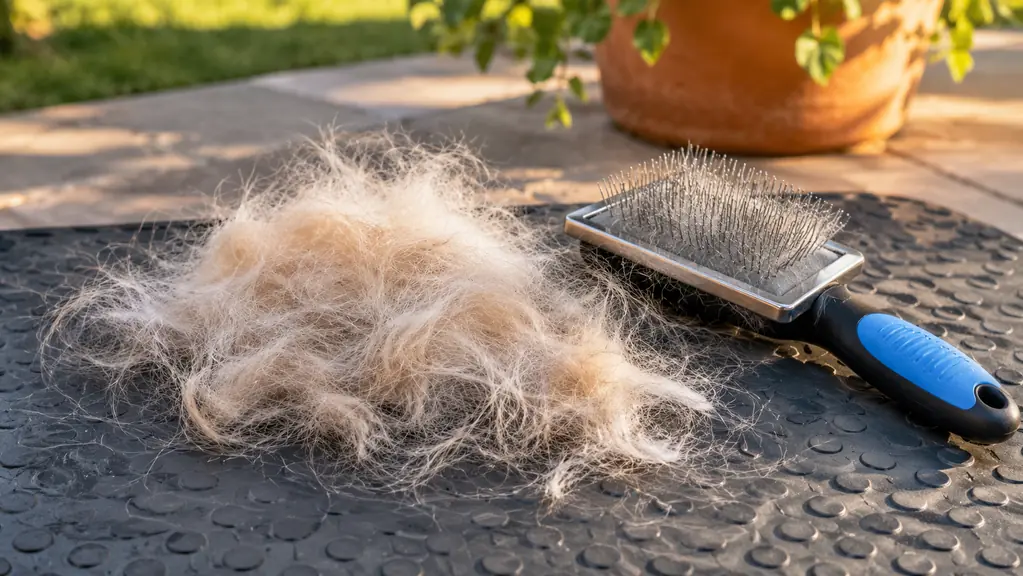
The handle holds up when the dog is sixty-four pounds of fluff
The brush is oblong, about five ounces, with a plastic body and a rubber grip, and the weight sits where it should in your hand. That matters in October, when the coat blows and I am out there twenty to thirty minutes twice a week instead of five. The listing mentions balance and less wrist and palm fatigue, which sounds like brochure talk until you have brushed a double coat for half an hour straight. My wrist notices the difference.
It lifts loose undercoat, so less of it ends up on my tile
There is tile in my kitchen and laundry room and carpet everywhere else, and Bruno sheds on both. I am not going to tell you a brush stops a Chow from shedding, because nothing does. What the slicker does is pull the loose undercoat out onto the patio instead of letting it drift through the house. By the second week of daily use I was seeing fewer tumbleweeds along the baseboards. Ten months in, that is still the pattern.
It is gentle enough to use every single day
A daily tool only works if it is not scraping skin. The pins on this one are thin and flexible, and they give instead of digging in when I hit a bony spot along the shoulder. The listing includes skin massage among the benefits and I will not oversell that, but I will say Bruno leans into the brush on his shoulders now, which he never did with the pin brush. When I find an irritated patch, I skip it entirely.
It replaced my pin brush outright
The pin brush went into the donate box in February. It had a cushion and round-tipped pins and it did a fine job on the surface of the coat, which was exactly the problem. The WOPQAEM brush does what the pin brush did and gets under the top layer as well, and it cleans itself, so there was no reason to keep both. One brush on the shelf, one spot on the rubber mat. Simple is what actually gets done on a Tuesday night in November.
It is the daily half of a two-tool system, not a replacement for the rake
I bought the WOPQAEM slicker in the same January order as a Maxpower Planet undercoat rake, and neither one replaces the other. The rake comes out Sunday mornings for twenty to thirty minutes, using the seventeen-tooth side for thinning, and twice a week during the April and May blow and again in October. The nine-tooth side is for mats and tangles only. The slicker handles the five daily minutes in between, and that division of labor is the whole system.
What I'd Skip
Three things, plainly. First, the blade-style deshedding tool I used through 2025. It pulled hair, sure, but it left Bruno's guard coat looking cut and ragged along the flanks, and I stopped using it. Second, skipping the rake because the slicker feels like enough during a coat blow. It is not. The slicker handles the surface and the loose top layer; the deep undercoat in April needs the seventeen-tooth side of a rake or it stays in there and mats. Third, brushing straight over a hot spot or an angry patch of skin just to finish the job. Bruno had one hot spot on his neck under the ruff in August 2025 and it took a vet visit to clear it. If the skin is irritated, put the brush down and call your vet. A slicker is a grooming tool, not a treatment.
Within three weeks there were no new mats behind his ears. Ten months later, that is still the line I would put on the box.
The brush a stubborn Chow will stand still for
Five minutes a night on the ruff, behind the ears and the pants, then press the release button and wipe the pins clean. It will not stop the shedding, and no brush will, but it keeps the mats from starting in the first place.
Amazon Check Today's Price on Amazon →