
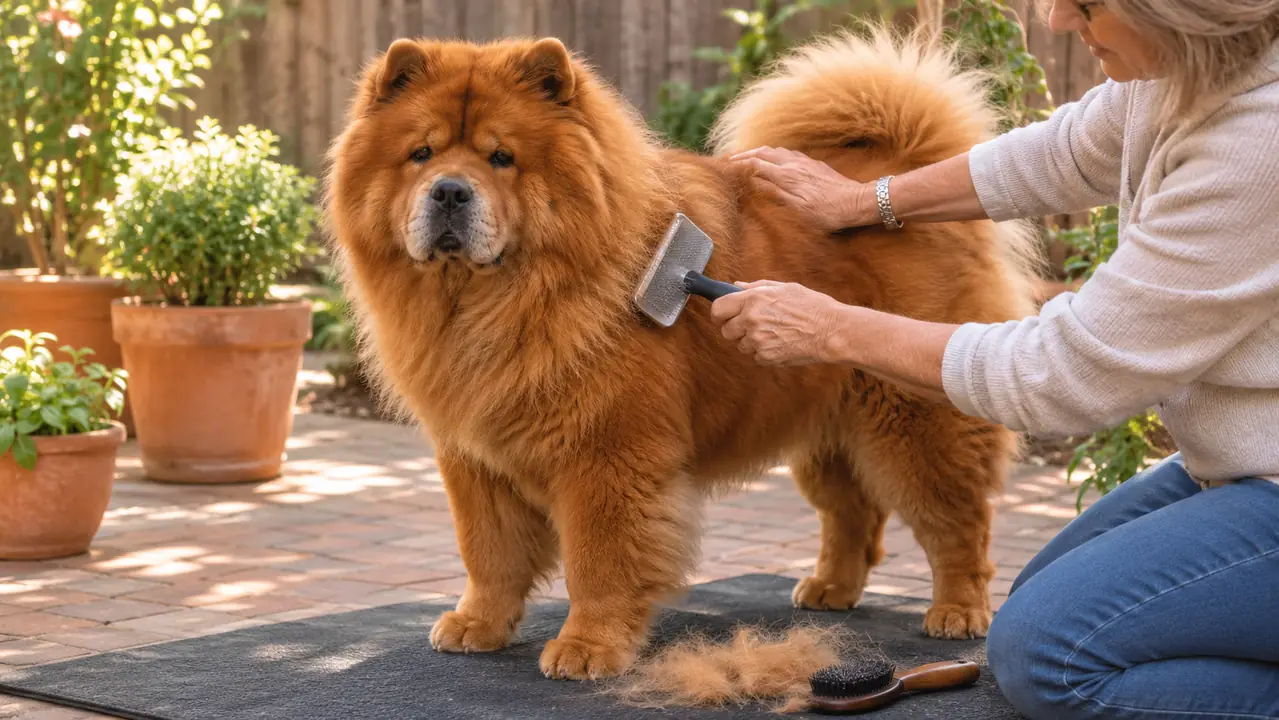
Bruno is seven, sixty-four pounds, and shaped like a cinnamon red ottoman with opinions. He is my first Chow and, at this point, my only dog. I am sixty and retired after thirty years working in a school office, so my days are quiet in a way I spent three decades wishing for. What I did not expect was how much of that quiet would get eaten by one dog's coat.
For years I brushed him with a metal comb and a pin brush and figured that was that. It was not that. The comb would skate over the surface of his ruff while the undercoat stayed put underneath, and the pin brush mostly rearranged the top layer so he looked groomed from six feet away. Behind his ears, where the coat is finest, I kept finding small mats I could not get out without pulling, and pulling is how you teach a Chow that grooming is a fight he intends to win.
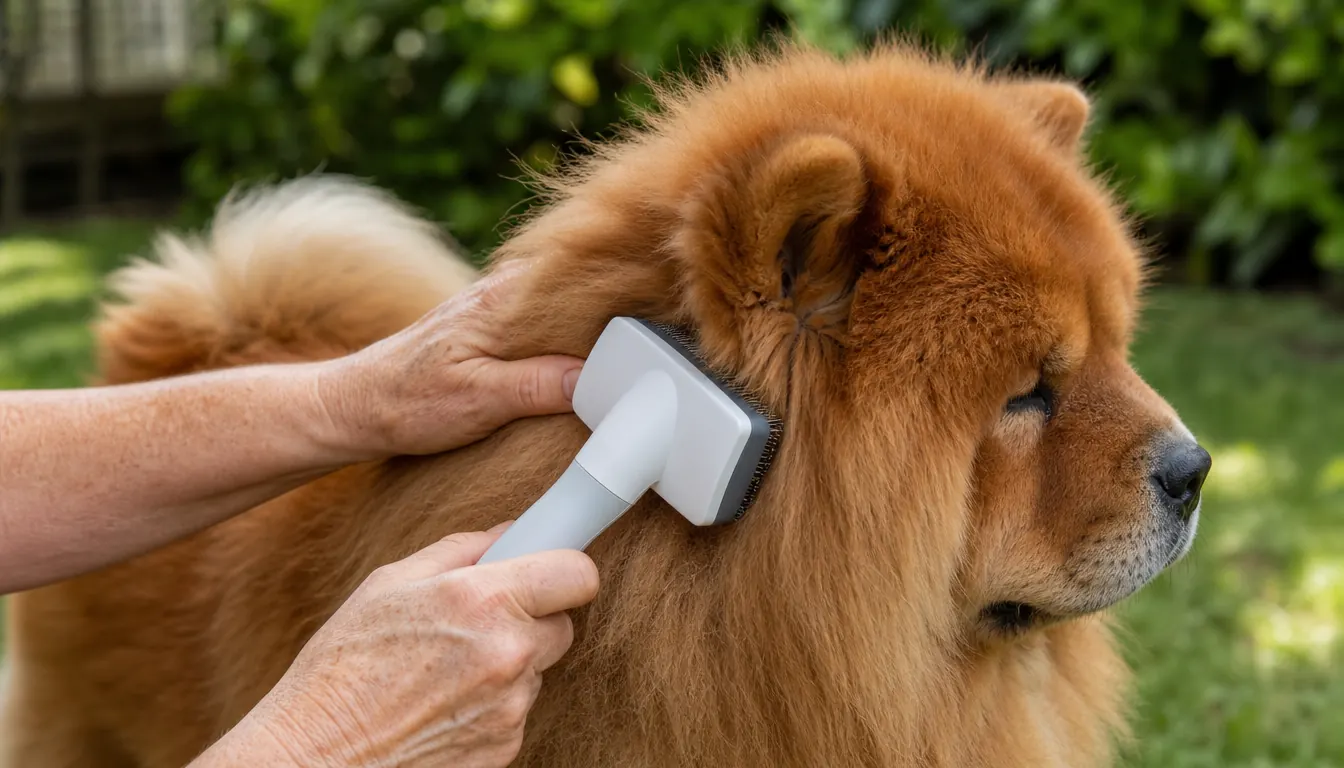
In January 2026 I finally bought two tools in one order: an undercoat rake and the WOPQAEM self-cleaning slicker brush. Ten months later, the slicker is the only thing I reach for every single day. Five minutes in the evening, on the ruff, behind the ears, and along the pants on his back legs. That is the whole routine.
Here is what I noticed first. The WOPQAEM has fine stainless steel pins set at an angle, and that angle is the reason it works on a coat like Bruno's instead of bouncing off it. A straight pin rides the top. An angled pin gets down under the guard hair and drags the loose fluff out. I am not a groomer and I cannot explain the engineering, but I can tell you the difference showed up in the first week, on the brush, in the form of a grey-brown cloud that had been living on my dog.
Within three weeks I stopped finding new mats behind his ears. Not because I got better at brushing. Because the tool was finally reaching the hair that was causing them.
The five-minute evening habit that ended the mats behind Bruno's ears
This is the daily tool. The button on the handle retracts the pins so the hair wipes off in one pass, which means I actually clean it instead of letting it clog.
Amazon Check Today's Price on Amazon →I want to be honest about the button, because that is the part people ask me about. You press the release button on the handle and the pins retract, and the whole pad of hair lifts off in one piece. Before this I had a brush I dreaded cleaning, so I did not clean it, so it dragged. Now it takes four seconds and I do it every night without thinking. That sounds like a small thing. It is the reason the habit stuck.
The handle is plastic with rubber in it and the whole brush weighs about five ounces. I have arthritis in my right thumb and I can hold it through a full five minutes without my hand cramping, which was not true of the comb. It is oblong and fits in the palm, and Bruno tolerates it because I am not sawing at him.
The slicker did not replace everything. It replaced the pin brush, and that is all it replaced. Sunday mornings are still rake mornings, twenty to thirty minutes on the patio with the two-sided rake, the nine-tooth side for anything tangled and the seventeen-tooth side for thinning out the undercoat. Twice a week during the coat blows in April and May, and again in October. Daily slicker, weekly rake, and neither one does the other's job. If I skipped the rake, the slicker would be doing triage instead of maintenance.
What I'd Tell You If We Were Sitting at My Kitchen Table
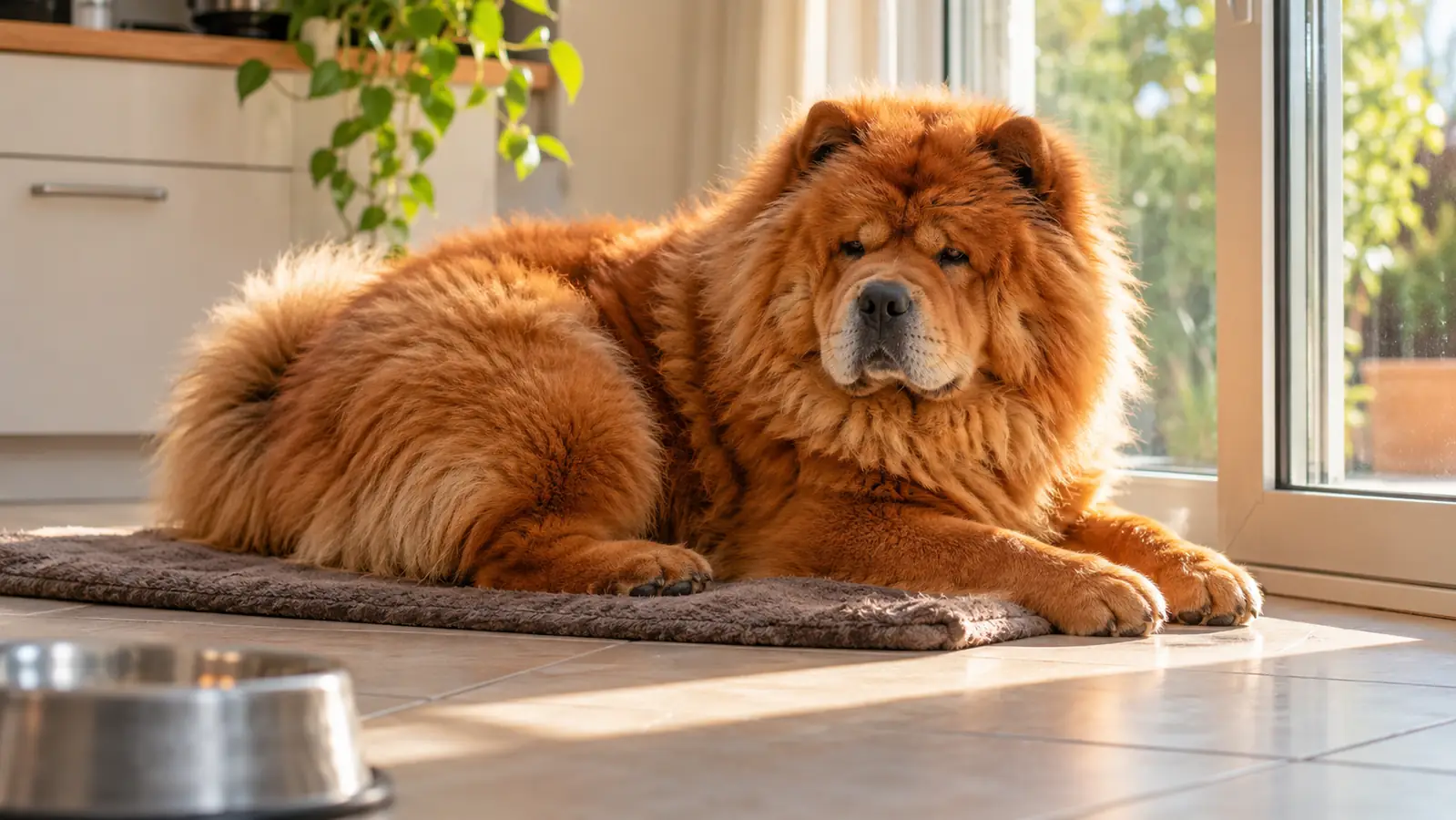
I would tell you that a Chow's coat is a weekly job, not a crisis, and that most of the misery people describe comes from using one tool for everything. The WOPQAEM slicker is the daily five minutes. A rake is the Sunday session. You are buying two things, and pretending otherwise is how people end up frustrated and back on the pin brush by March.
I would tell you it does not stop shedding. Nothing stops shedding. Bruno still drops coat, still leaves tumbleweeds on the tile, still needs the rake in April. What changed is that the loose hair comes out on a brush in my hand instead of migrating into the corners of the laundry room and into the coat where it felts into mats.
I would tell you to go slow behind the ears and never rake over a hot spot or irritated skin. Bruno had one hot spot, on his neck under the ruff, back in August 2025, and Dr. Nwosu treated it. When skin is angry, you stop. And I would tell you not to expect a stubborn dog to volunteer. Bruno cooperates because the session is short and ends before he gets bored. Make it long and he remembers, and a Chow who remembers a bad grooming session will make you pay for it for a month.
I would also tell you to check the pins with your fingertips before the first pass, the way you would check a seam. The ends on this one are rounded and I have never caught his skin with them, but you should look anyway, because a bent pin on any brush will scratch and you will not notice until the dog tells you.
One more thing, plainly: I am not a vet and not a professional groomer. I am a woman on a patio with a rubber mat and a dog I have had since he was nine weeks old. This is what worked in my house. Your dog's coat may be thicker, thinner, or attached to a personality with stronger opinions than Bruno's. But five minutes of the right brush beats an hour of the wrong one, and that is the whole of what I know.
Ten months in, this is still the brush I pick up every night
Five minutes on the ruff, behind the ears and along the pants. The pins retract with the press of a button so it is clean before you put it down.
Amazon Check Today's Price on Amazon →