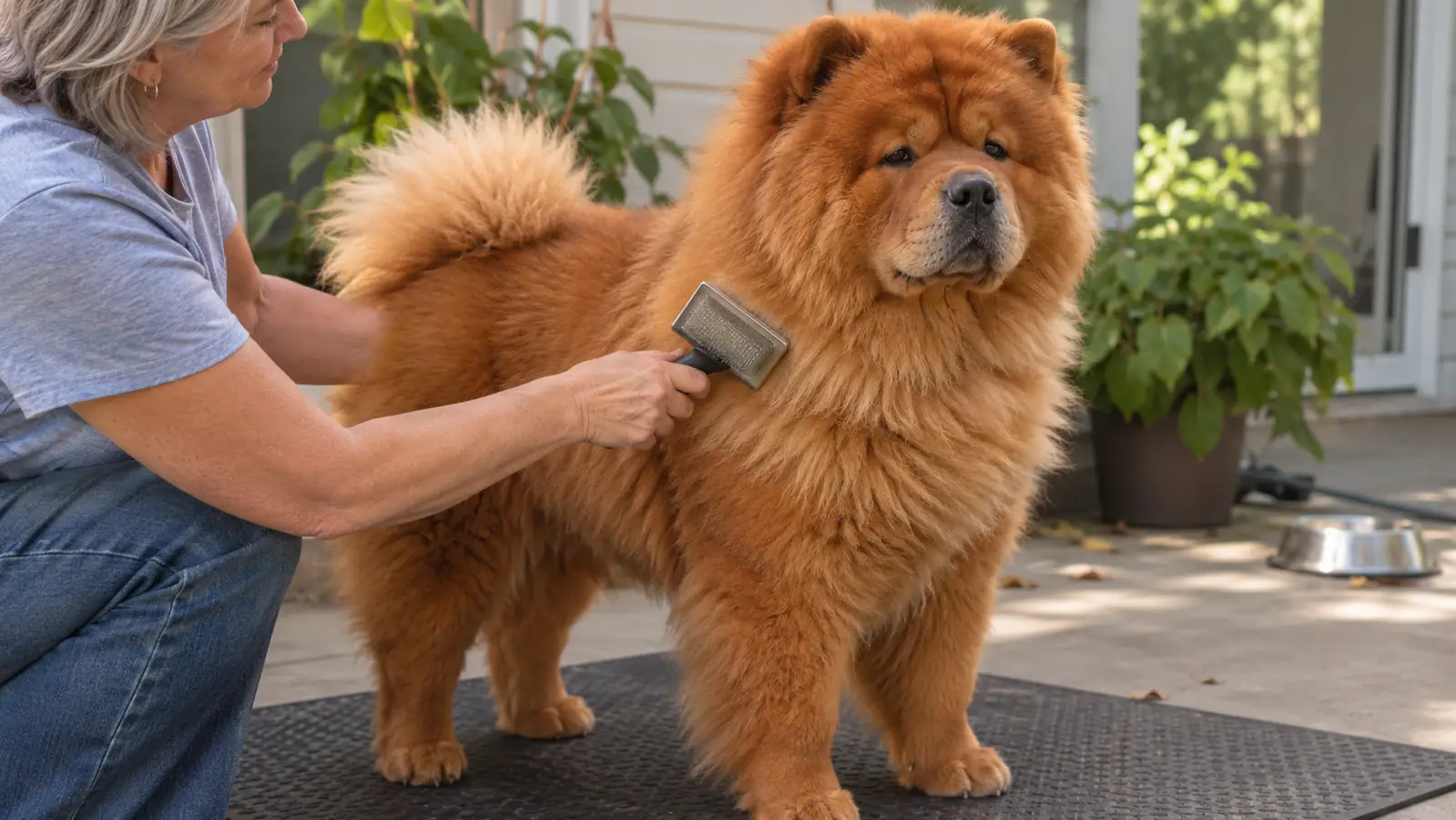
If you own a Chow, the ruff is the whole argument. It is not a coat in the usual sense. It is a thick collar of hair that traps everything, sheds twice a year with real enthusiasm, and mats behind the ears if you look away for a week. I am Bev Lindqvist, I live in Fort Collins, Colorado, and my dog is Bruno, a seven-year-old cinnamon red rough-coat Chow Chow who weighs 64 pounds. For years I used a pin brush because that is what I had. In January 2026 I bought a WOPQAEM self-cleaning slicker brush. Ten months later the pin brush sits at the bottom of the grooming bin. The short answer for a Chow ruff is the slicker. The pin brush is a finishing tool, not the main event.
That is not a knock on the pin brush. A pin brush has its place. It is simple, it has no button to press, and it moves over a tender spot with less drag than a slicker. But a Chow ruff is dense, and dense is where a pin brush runs out of ideas. The WOPQAEM slicker has fine-wire stainless pins angled at 135 degrees, and those pins get down into the undercoat where the mats actually start. The pin brush mostly lifts what is already loose on top. If you are choosing one tool for a Chow, choose the slicker. If you already own both, read on, because the pin brush still earns a small job in our house.
| WOPQAEM Slicker | Pin Brush | |
|---|---|---|
| Undercoat reach | Fine-wire stainless pins angled at 135 degrees catch loose undercoat fur where mats begin. | Pins mostly lift the top coat and leave the undercoat underneath. |
| Daily mat prevention | Five minutes in the evening keeps the ruff and the area behind the ears clear. | Smooths the surface but does not separate the undercoat. |
| Comfort on sore or thin areas | The stainless pins are firm, so I go around a hot spot or red skin. | More give in the pins, which is easier on a tender flank or belly. |
| Finishing the surface | Leaves the ruff shaped but is more tool than a quick tidy needs. | A few light passes lift the surface and make the ruff look finished. |
| Cleaning the tool | Press the release button, the pins retract, and the hair wipes off. | Hair wraps around the pins and has to be picked out by hand. |
| Control in a thick ruff | Oblong head and a rubber grip give steady control in dense hair. | Light and simple, but it skates over a full Chow ruff. |
| Best for | Double-coated dogs that need daily undercoat work. | A quick surface tidy or a dog with a thinner coat. |
What a Chow Ruff Is Up Against
Bruno's ruff is thickest at the neck and chest. That is also where he is least interested in being brushed. He will stand for the back and the pants. He will lean away when I go near the front of the ruff, not because it hurts, but because he has opinions. A Chow cooperates when he thinks grooming was his own idea. So the tool has to do its work in short passes, with one hand on his chest and one hand on the brush. A tool that needs long, repeated strokes through the same spot is a tool that turns a five-minute job into a negotiation.
The other problem is the double coat. The guard hairs are long and coarse. The undercoat is soft and dense, and it sheds into the ruff instead of falling on the floor. A pin brush can smooth the guard hairs and make the surface look tidy. It does not separate the undercoat. The mats behind Bruno's ears were never surface mats. They started underneath, close to the skin, and by the time I felt them they were already tight. The slicker is built for that layer. The WOPQAEM pins are fine and closely set, and the oblong head is small enough to work behind an ear without banging into his jaw.
I am not a vet and I am not a professional groomer. Dr. Amara Nwosu is our vet, and she is the one who found mild hip dysplasia on Bruno's X-rays in February 2026. She also treated the one hot spot he has had, on his neck under the ruff, in August 2025. I mention that because a hot spot changes how you brush. You do not rake or scrub over irritated skin. You go around it. A slicker can be used lightly around the edge if the skin is calm, but if the skin is red or broken, the brush stays in the bin and the vet gets a call. That is not a brush decision. That is a dog decision.
I bought the WOPQAEM slicker and the Maxpower Planet rake in the same January order because I finally admitted the pin brush was not doing the job. The rake was for the weekly undercoat work. The slicker was for the daily five minutes. They do different things. The rake has teeth and reaches the undercoat in a different way. The slicker has fine pins that lift the loose hair so it can be wiped off. Neither one replaces the other. The pin brush was the odd one out. It was never the main tool. It just took me seven years to say that out loud.
Where WOPQAEM Wins
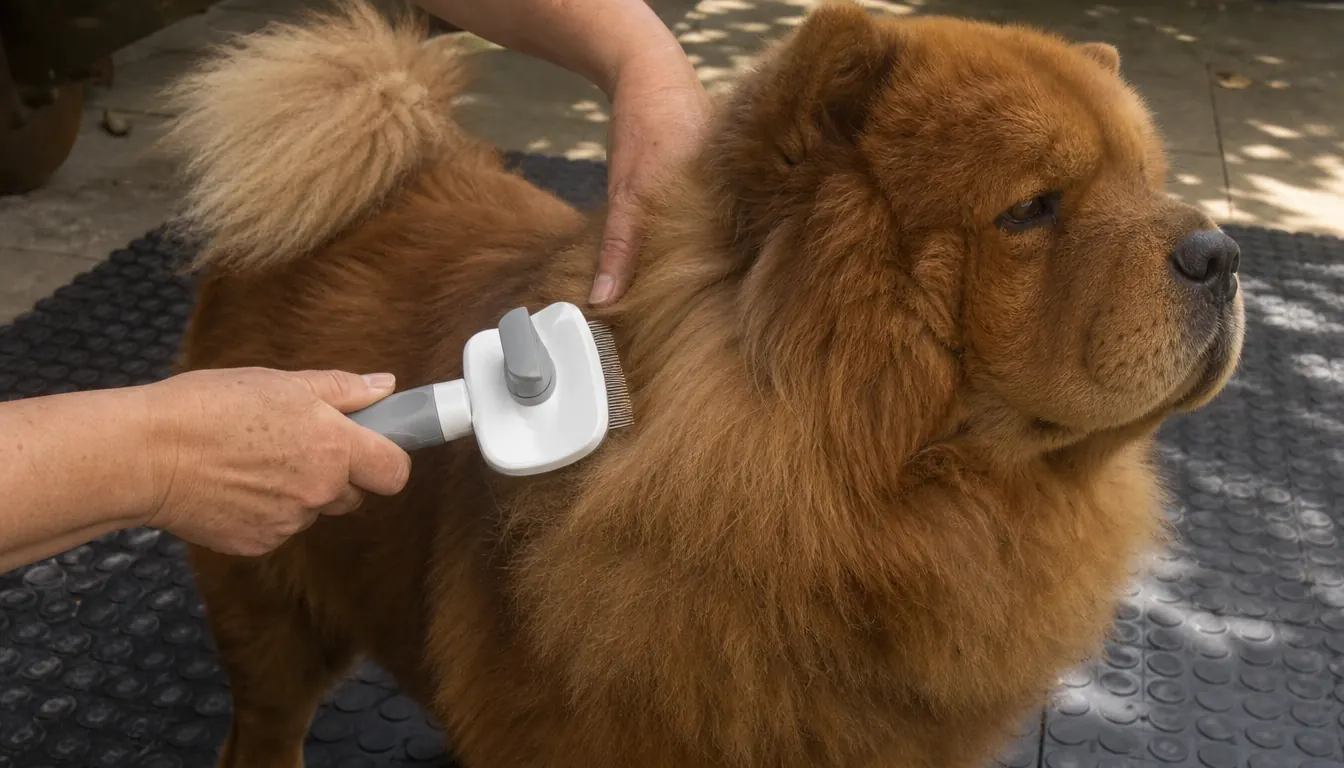
The first win is undercoat reach. The WOPQAEM pins are angled at 135 degrees, and that angle lets them catch loose undercoat fur instead of skating across the top. I use it daily, about five minutes in the evening, on the ruff, behind the ears and the pants. Within three weeks I stopped finding new mats behind his ears. Not because I was brushing harder. Because I was getting under the surface where the mats begin. A pin brush never did that for me. It made the ruff look smooth and left the underneath alone.
The second win is the self-cleaning button. This sounds like a small thing until you have spent ten minutes picking Chow hair out of a pin brush. You press the release button on the handle, the stainless pins retract, and the hair wipes off in one piece. I do it over the patio, not over the kitchen tile. The tool is 7.09 by 3.94 by 2.56 inches and weighs 5.29 ounces, so it is easy to hold in one hand while the other hand keeps Bruno steady. The handle is plastic with TPR rubber grips, and the oblong head fits into the curve behind an ear. That matters on a dog who hates having his back feet touched and will absolutely use that as an excuse to leave.
Where the Pin Brush Wins
The pin brush wins on comfort. Not on a thick ruff, but on the places where the coat is thinner or the skin is sore. Bruno has a spot on his flank where the hair is shorter, and the slicker is too much there. The pin brush glides over it. When he had the hot spot in August 2025, the pin brush was the only tool I used near the edge, and even then I used it lightly. A pin brush has more give. It does not dig. On a dog who is already cranky about grooming, that give can be the difference between a finished session and a dog walking off.
The pin brush also wins on finishing. After the slicker has done the undercoat work, a few passes with the pin brush lift the surface and make the ruff look shaped instead of combed. It is the difference between a dog that has been groomed and a dog that has been groomed and then fluffed. I still use the pin brush for that, maybe once a week, for two minutes. It is also simpler to clean than a slicker if you only have a little surface hair, because there is no button and no retracting mechanism. That is a real advantage for a quick tidy on a calm dog. It is not enough for a Chow ruff in full coat.
If the mats start under the ruff, start with the tool that reaches them
The WOPQAEM self-cleaning slicker is the daily brush in our house. Press the button, the pins retract, and the hair comes off. It is the tool I reach for on Bruno's ruff, behind his ears and on his pants, five minutes at a time.
Amazon See the WOPQAEM Slicker on Amazon →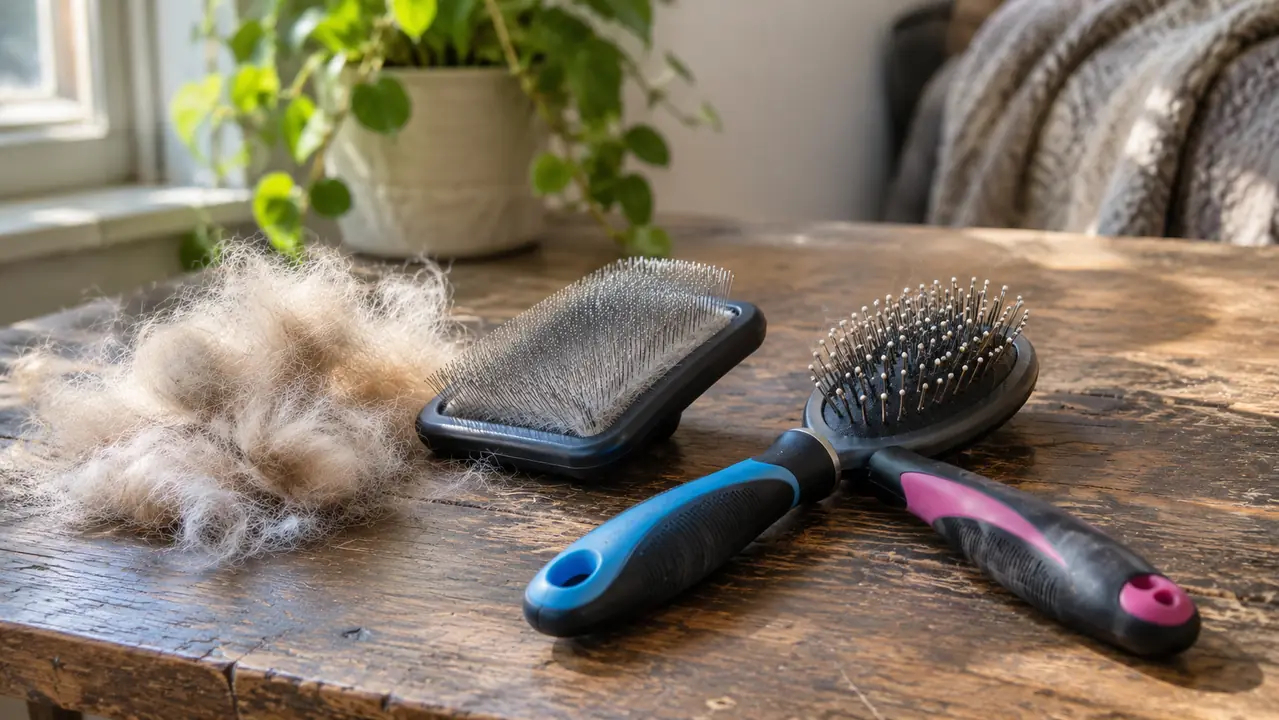
How I Use Both on Bruno
My routine is not fancy. Sunday morning is rake day on the back patio. I use the Maxpower Planet undercoat rake, the 17-tooth side for general deshedding and the 9-tooth side only if I find a mat. I do not rake over the hot spot area or any red skin. Then, in the evening, I use the WOPQAEM slicker for five minutes. The rake does the heavy lifting once a week. The slicker keeps the ruff from turning into a felt pad the other six days. The pin brush comes out after the slicker if I want the ruff to look finished. That is the whole system.
On bath day, Dan holds the leash and I do the washing in the garage. We use a plastic tub on the floor, a hose from the utility sink and a rubber mat. The DOPICT high velocity dryer does the rest. I use the lowest heat, start on low speed, keep the nozzle moving and never point it at his face or ears. Drying takes about 40 minutes now, against about three hours of towels and air before. A coat that is dry to the skin is the reason I bought the dryer. A damp ruff is where the hot spot in August 2025 started, and I am not doing that again. The slicker goes back to work the next evening.
A pin brush made the ruff look smooth. The slicker is the one that kept the mats from forming underneath.
The Mistake I Made With the Pin Brush
For years I thought a pin brush was enough because it made Bruno look good. That is the trap. The surface looked smooth, so I assumed the coat was fine. Then I would find a mat behind his ear the size of a grape and have to work it out with a comb, which he hated. The pin brush was not creating the mats. It was hiding them. The slicker does not hide anything. It pulls the loose undercoat up and out, and you see exactly what you are dealing with. That is less pleasant to look at. It is better for the dog.
The other mistake was brushing harder when the pin brush did not get through. That is the wrong answer on a double coat. If a tool is not reaching the undercoat, pressing down does not make it reach. It just annoys the dog. The WOPQAEM slicker works with light passes. I let the pins do the work and I keep my wrist loose. If I hit a mat, I switch to the 9-tooth side of the rake and work it from the edge, not from the top. If the mat is tight against the skin, I stop and call the groomer. That has happened once since January. I am not too proud to hand the mat to the groomer.
Who Should Buy Which
Buy the WOPQAEM slicker if you have a Chow, a rough collie, a German shepherd, or any dog with a dense double coat and a ruff that mats behind the ears. Buy it if you are doing the coat work yourself and you want one tool that reaches the undercoat without a long session. Buy it if you are tired of picking hair out of a pin brush. The self-cleaning button is not a gimmick. It is the reason I use the slicker daily instead of avoiding it. A tool you actually use is worth more than a tool that looks nice in the bin.
Keep the pin brush if your dog has a thinner coat, if he is sensitive around the flank or the belly, or if you want a finishing tool after the slicker. Keep it if you have a puppy or an older dog who will not tolerate a firmer brush for long. Do not expect it to handle a Chow ruff on its own. It will make the surface look neat. It will not keep the undercoat from matting. For Bruno, the slicker is the daily tool and the pin brush is the two-minute finish. That is the honest division of labor in our house.
The daily brush that earned its place in the bin
If your Chow's ruff mats behind the ears, the WOPQAEM slicker is the tool to start with. Five minutes in the evening, press the button to clean it, and put it away. The pin brush can stay for the finish.
Amazon Check the WOPQAEM Slicker on Amazon →