
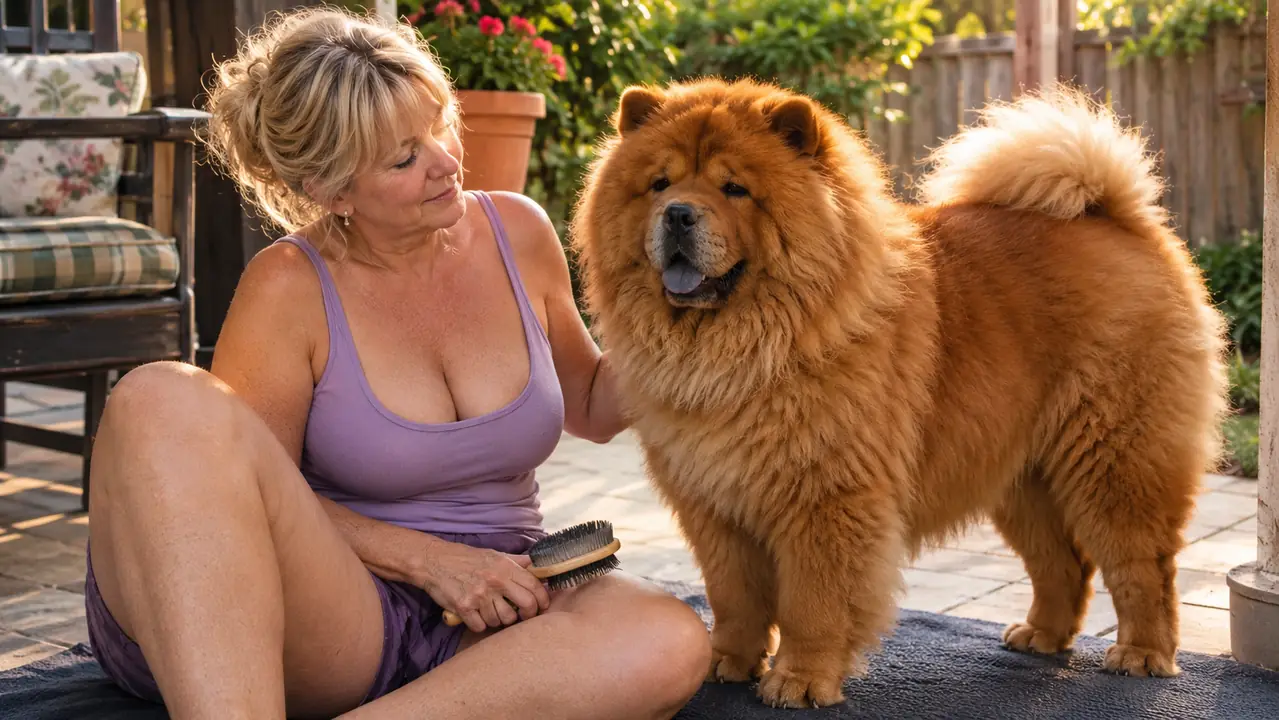
Mats on a Chow Chow rarely announce themselves. They start as a soft knot behind an ear or a tangle where the back leg meets the pants, and then one morning you find a felted lump the size of a walnut that will not come apart for love or money. I spent most of 2025 finding those lumps. Bruno is my rough-coat Chow, 7 years old, 64 pounds, and for his first six years I treated his coat like a weekend chore: metal comb, pin brush, good intentions.
By the time I got the comb out, the mats were already set. So I did what most people do. I pulled harder, which Bruno hated and which made him leave the room the next time I picked up a brush. What actually fixed it was not a stronger tool or a longer session. It was five minutes a day with a self-cleaning slicker brush, the WOPQAEM one, done the same way at the same time so he could predict it. Ten months in, I can tell you exactly how the routine works, and where it still is not enough.
Five minutes with a slicker that reaches the undercoat beats an hour of pulling
WOPQAEM's slicker has fine stainless steel pins set at an angle to get under the top coat, and a button on the handle that retracts the pins so the hair wipes off in one pass. It is the daily tool in this house. The rake does the weekly work.
Amazon Check Today's Price on Amazon →Step 1: Set It Up So the Grooming Looks Like His Idea
A Chow does not come when you call him for grooming. Bruno is aloof with everybody, me included, and the fastest way to lose him for the evening is to walk toward him holding something. So I stopped walking toward him. The rubber mat lives on the back patio, and in the late afternoon I sit down on it with the brush in my lap and wait. He investigates anything at his own level. Within a minute or two he is standing over me, sniffing the brush, and the session starts on his terms instead of mine.
Timing matters as much as the setup. Bruno pants hard once it passes about 80 degrees, and a hot dog does not want to be brushed. Fort Collins in July is not the hour for a long session. Late afternoon in the shade works. In the colder months I move the whole thing to the hour after his afternoon walk, while he is still standing around and I still have daylight. Same mat, same order: the ruff first, then behind the ears, then the pants. He knows the order now, and a dog who knows the order stops bracing.
The brush itself has to be easy to hold. This one weighs 5.29 ounces, with an oblong head measuring 7.09 by 3.94 by 2.56 inches, a plastic handle and a rubber grip. That sounds like a small thing. It is not. A brush that makes your wrist ache by minute three is a brush you quietly stop reaching for by week two.
My first attempt back in January was in the living room, on the carpet, and it lasted about ninety seconds. Bruno stood up, walked to the hallway, and lay down facing away from me. Carpet holds the hair, the television was on, and I was leaning over him instead of sitting at his level. Moving the whole operation outside to the rubber mat was the largest change I made that month, and it cost nothing. It worked better than any tool I bought.
Step 2: Work in Sections, Down to the Skin, With the Coat
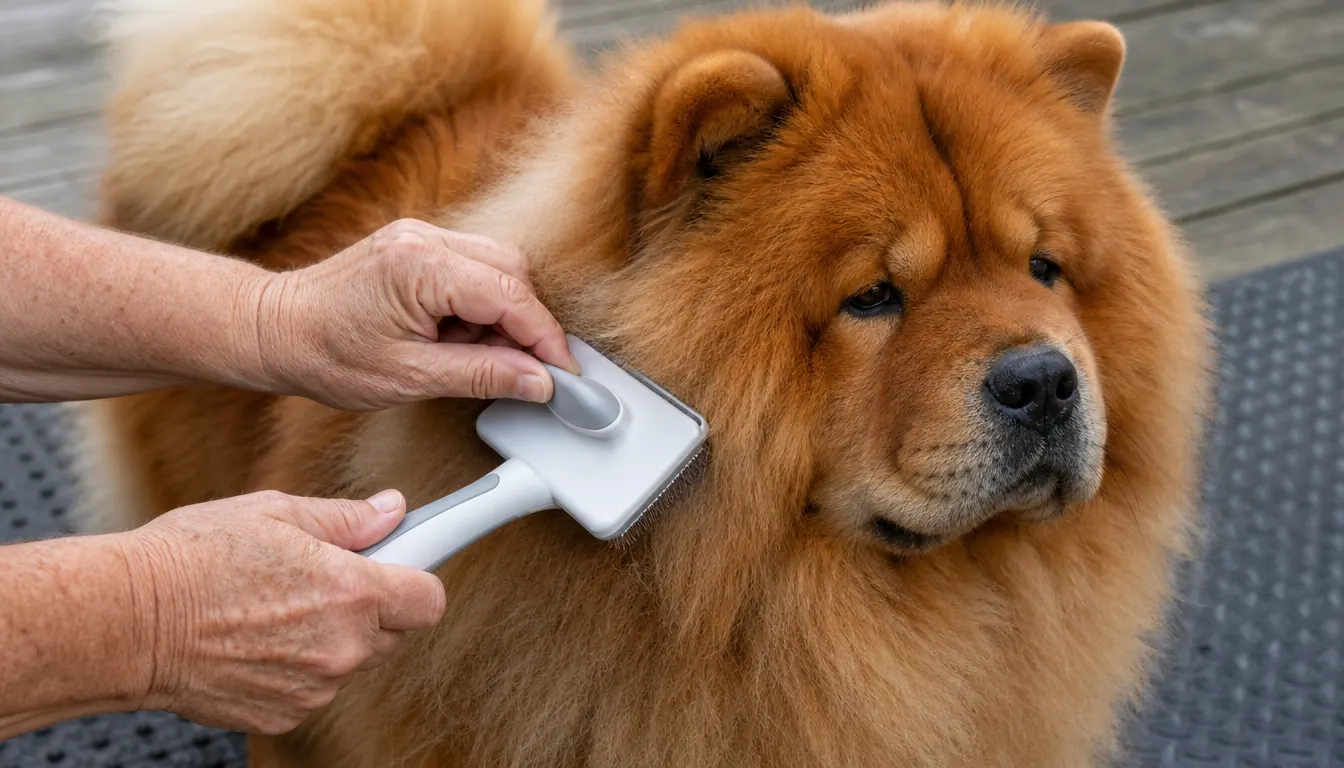
A Chow coat is two coats. There is a harsh outer layer and a dense woolly undercoat, and the mats form in the undercoat, close to the skin, where you cannot see them. Brushing the top of the coat feels productive and accomplishes almost nothing, because the pins skate across the outer layer and never touch the knot underneath.
So I part the coat with my free hand, push the hair forward until I can see skin, and brush that section in the direction the hair grows, in short strokes. Section by section across the ruff, then behind the ears, then under the front legs, then the pants on the back legs, then the base of the tail. The pins on the WOPQAEM brush are fine wire, angled at 135 degrees, and that angle is the whole point. They get under the top layer instead of sliding over it. On a dog this size, the difference between a slicker that reaches the undercoat and one that does not is the difference between five minutes and twenty.
Pressure stays light. The pins are stainless steel and they will scratch if you lean on them. I let the brush do the work and I keep my hand flat under the section I am brushing, so I can feel whether I am dragging on skin. The back feet are off limits. Bruno has hated having his back feet touched since he was a puppy, and I have decided that is not the hill to die on. The pants get brushed. The feet get left alone.
Here is how I check my own work. After I finish a section I push the hair back the other direction and look at the skin. If I can see pink and a clean part, the section is done. If I still see a greyish woolly layer packed together, I go back over it. On the ruff, which is the thickest part of him, that check takes about thirty seconds, and it is the difference between a coat that stays loose all week and one that is felted again by Thursday.
Step 3: Five Minutes a Day, Not an Hour on Saturday
A mat is shed undercoat, moisture and friction pressed together over time. Every day you skip, that day's loose hair stays in the coat and adds to the pile. Frequency is the method. Five minutes in the evening, every evening, catches the undercoat before it felts.
I used to give Bruno one long session on a Saturday with the comb and the pin brush, and I was proud of it. It was the wrong shape of effort. Two hours once a week lets six days of shedding build up first, and then you spend the session pulling apart knots that never had to form. Five minutes daily means I am mostly brushing out loose hair, which he tolerates, instead of fighting mats, which is when he leaves.
Within three weeks there were no new mats behind his ears. Not fewer. None. Nothing else about the routine changed.
Twice a year the coat blows, in April and May and again in October, and five minutes stops being enough. During a blow I brush twice a day and I bring in the rake. That is the season that decides whether you have a mat problem or not, and it is the one time of year I will say a Chow's coat is genuinely work.
The April 2026 blow was the first one I did entirely myself, and I badly underestimated it. I was finding tufts on the tile every morning for three weeks. What helped was adding an evening session and going over the pants and the ruff with the 9-tooth side of the rake first, then the slicker. By the October blow I knew the shape of it, and the tufts were gone in ten days instead of twenty-one.
Step 4: Clear the Pins as You Go, and Treat a Mat Properly
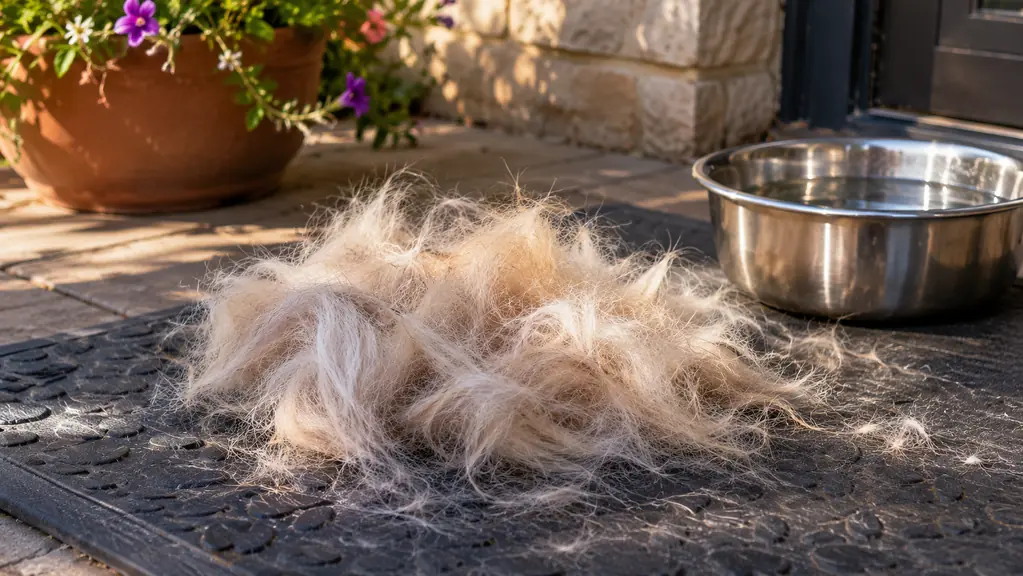
Here is the part nobody mentions about slickers. A loaded brush stops working. Once the pins are packed with undercoat they cannot grab anything new, and you end up polishing the same square inch for a minute. The WOPQAEM brush has a button on the handle, and pressing it retracts the pins so the pad of hair wipes off in one motion. I do that every couple of minutes, over the mat, so the hair lands in one place instead of across the patio.
Ten months of this and the volume still surprises me. On a Sunday in the middle of the May blow I half filled a plastic grocery bag from one session. That hair was coming off him either way. The only question was whether it came off into a bag on the patio or stayed in the coat and turned into felt.
When you do find a mat, do not cut it out and do not reach for the clippers. Cutting leaves a hole in the coat that takes months to grow back, and Bruno has never been shaved and never will be. Instead, break the mat into smaller pieces with your fingers, working from the outside edge inward, then go at what is left with the 9-tooth side of the rake, holding the coat at the base so you are not pulling on skin. A mat that is damp from a bath or from rain is worse than a dry one. Dry the coat first, then work.
And never rake or brush over a hot spot or red, irritated skin. Bruno had one hot spot in August 2025, on his neck under the ruff. Dr. Nwosu treated it and told me to leave it alone until it healed. I did. The slicker goes around trouble, not through it.
Step 5: Put the Weekly and Monthly Pieces on Their Own Schedule
The slicker is the daily tool and it is not the whole routine. Sunday mornings are the rake, 20 to 30 minutes on the patio, using the 17-tooth side for thinning and deshedding. Baths happen in the garage in the plastic tub, with Dan holding the leash, about every six weeks. Since February I have dried him with a high velocity dryer on the lowest heat, starting on low speed and keeping the nozzle moving. Drying takes about 40 minutes now, against the three hours of towels and air I used to spend.
Once a week I also run my hands over him with the brush in the other hand, looking for anything new. Redness, a warm patch, a lump that is not hair. A slicker will not tell you your dog has a skin problem. It just gets the coat off so you can see one before it becomes a vet visit.
What Else Helps
Two things made a difference in 2026 and neither of them is a brush. The first is weight. Dr. Nwosu found mild hip dysplasia on Bruno's X-rays in February and told me plainly that keeping his weight steady would do more for him than anything I could buy. A 64-pound Chow with sore hips does not want to stand through a long grooming session, so a short session and a steady weight are the same project.
The second is heat. From June through September he spends afternoons on a cooling mat on the kitchen tile by the patio door, and we skip the midday walks entirely. A cooler dog stands still longer, and a dog that stands still longer gets brushed properly all the way down. That is the whole connection between a mat on the floor and a coat without knots in it.
I am not a vet and I am not a groomer, and I will not pretend otherwise. If your Chow is fighting the brush, or has a spot that will not heal, or is suddenly lame, that is a vet visit and not a grooming problem. What I can tell you is what has worked in this house for ten months: five daily minutes with a slicker that actually reaches the undercoat, a weekly rake, a coat dried to the skin after every bath, and a routine predictable enough that a stubborn dog decided it was his own idea.
The tool I reach for every evening, not just on bath day
WOPQAEM's slicker retracts its pins with one press of the handle button, holds an oblong head sized for a ruff and a pair of back legs, and weighs 5.29 ounces, so five minutes stays five minutes. Add a rake on Sundays and the coat is covered.
Amazon Check Today's Price on Amazon →