
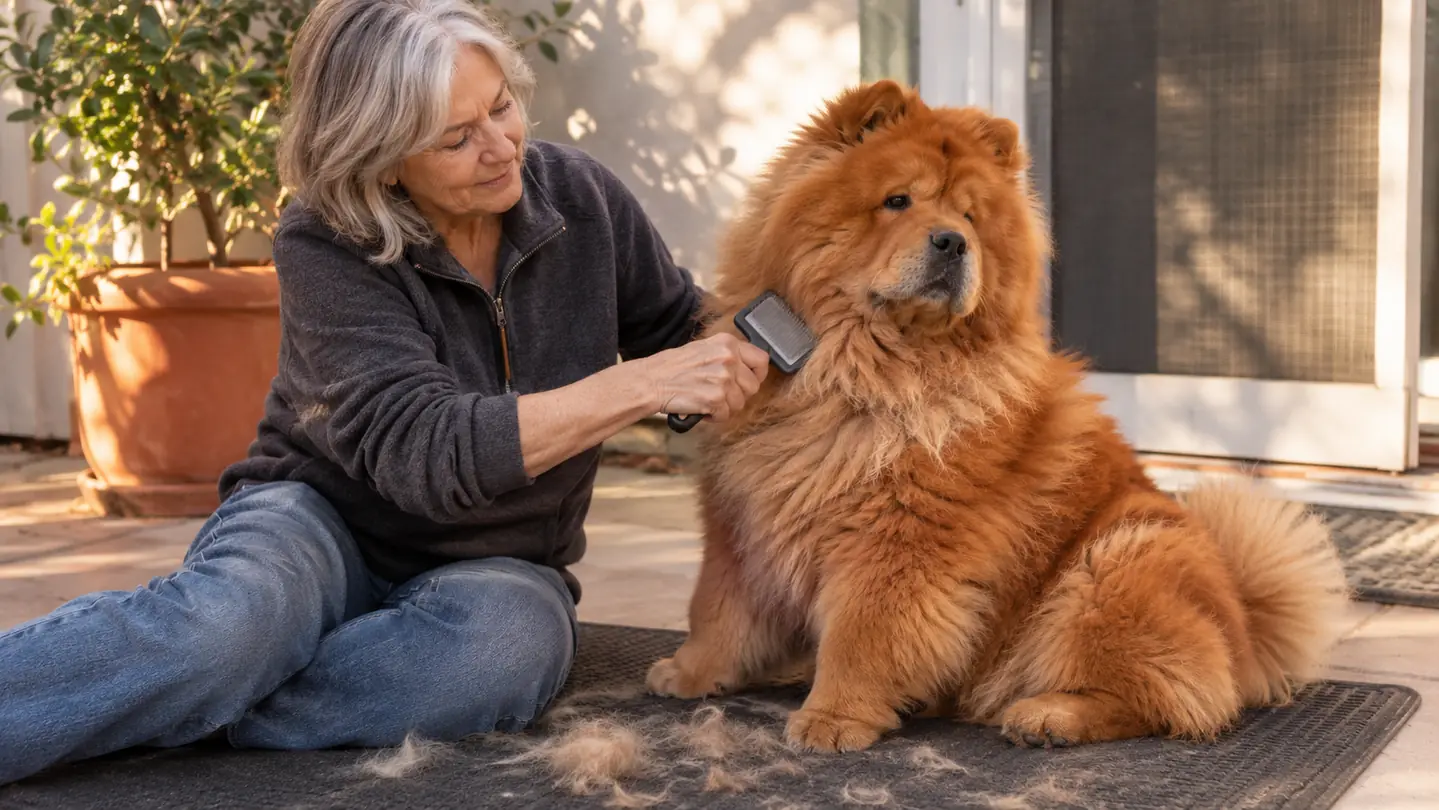
I bought the WOPQAEM self-cleaning slicker brush in January 2026, in the same order as an undercoat rake, and I have used it almost every evening since. That is ten months. Long enough to stop being polite about a tool. Here is the short version: it earned its place on the shelf by my back door, but not for the reasons the listing gives, and there are two things about it I wish someone had said out loud before I started.
Bruno is my Chow. Seven years old, sixty-four pounds, cinnamon red, and full of opinions. He hates having his back feet touched. He will hold still for the ruff and the pants if I am slow and if I let him sniff the brush first like the whole thing was his idea. That last part matters more than the brush does. A Chow who decides grooming is a wrestling match will win the wrestling match.
The Quick Verdict
A light, genuinely useful daily slicker for a thick double coat. The retracting pins keep it in the routine. It is a maintenance tool and it will not touch a mat, so do not buy it expecting a rescue.
Amazon Check Today's Price →The Five-Minute Evening Brush That Ended the Mats Behind His Ears
Ten months, near-daily use, one Chow with a coat like a mattress. This is the tool that stayed on the counter by the patio door.
Amazon Check Today's Price on Amazon →How I Use It Now, Ten Months In
Every evening, after his last trip outside and before the house settles, I sit on the kitchen tile with my back against the cabinet and go over three places: the ruff around his neck, the soft spot behind each ear, and the long feathered hair on the back of his legs that I call his pants. Five minutes. Six if the weather has turned cold and the coat has thickened up.
July evenings are the good ones. It is still light at eight, the patio door is propped open, and the tile in the kitchen has finally given up the heat it collected all afternoon. I sit with my back against the cabinet and he stands in front of me, facing away, which is his compromise. He will not lie down for this and he will not sit for it. Standing, facing away, with his head turned around to watch me out of one eye, that is the arrangement. I have learned not to fight the arrangement. When I do, the five minutes becomes twenty and I get maybe a third of the coat for three times the work.
February is the opposite. Dark by five, cold enough that the concrete out back bites through my jeans, and he will not stand on cold concrete for anybody. So in winter the whole thing moves to the laundry room floor, on the same rubber mat, under the overhead light. Same five minutes, different room, hair into the same bin. Ten months of that and the routine has held, which is more than I can say for the six years before it, when I brushed when I thought about it and paid a groomer twice a year to undo the result.
Sunday mornings are the rake. Twenty to thirty minutes on the rubber mat out on the back patio, and twice a week during the coat blows in April and May and again in October. The slicker is the daily tool. The rake is the weekly tool. Neither replaces the other, and anyone who tells you one brush does the whole job on a double coat has not lived with a double coat.
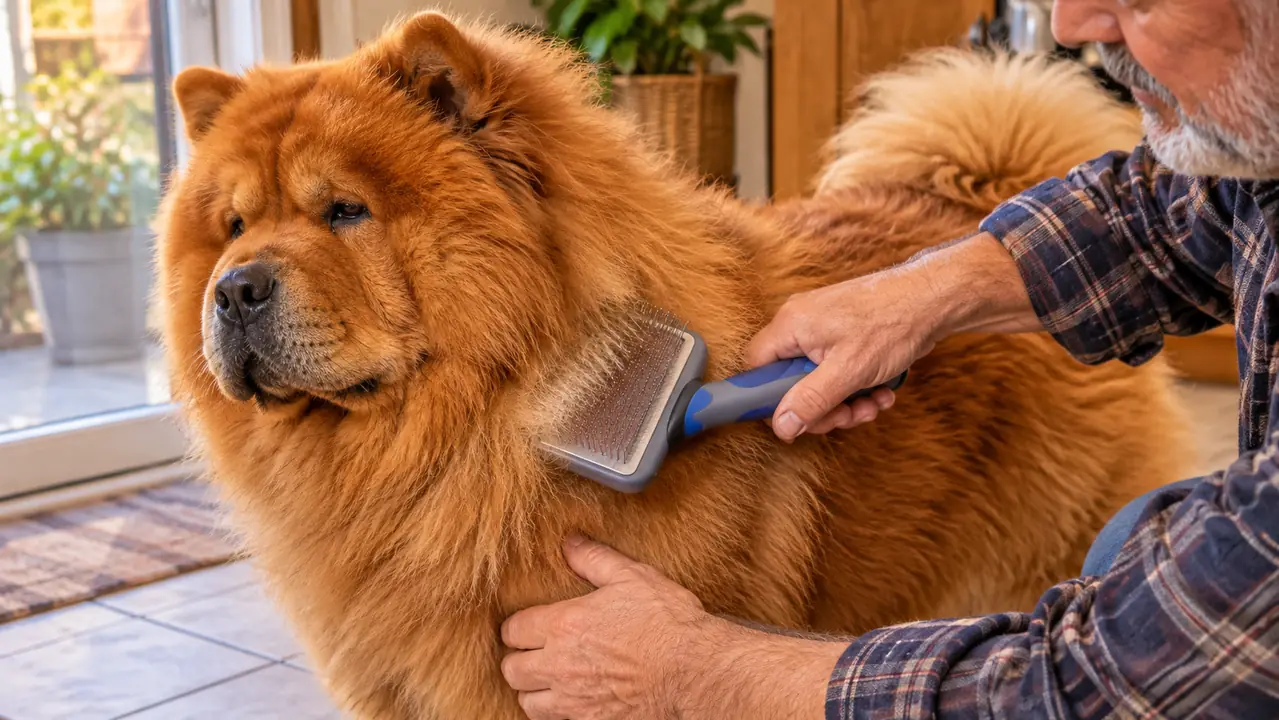
The WOPQAEM brush replaced a pin brush I had used for years. The pin brush was fine, honestly. It moved surface hair around and made the coat look tidy for an afternoon. What it did not do was get underneath. These pins are fine stainless steel set at an angle, and that angle is the whole difference. It reaches down into the woolly undercoat instead of skating along the top.
What Nobody Tells You: The First Three Weeks Are Not About Hair
Everybody wants to know whether it cuts down shedding. It does, some. But the first three weeks are not about hair at all, they are about a dog learning that this object is not a threat. Bruno is not a nervous dog, he is a proud one, and a Chow that has decided a tool is suspicious will not be talked out of it with a cheerful voice. I spent the first week letting him sniff the brush, brushing for thirty seconds, and quitting while he was still relaxed. Thirty seconds felt ridiculous. It was the right call.
The first real attempt was a mess and you should hear about it. I sat down on the patio in the middle of January with the plan of doing the whole coat, and about forty seconds in he stood up, turned around, walked to the far side of the yard and sat with his back to me. Not aggressive. Not frightened. Just finished. My mistake was wanting the entire job on the first night. I had spent years watching a groomer do this work while I stood there with my hands in my pockets, and I had convinced myself I knew what the whole job looked like. I did not know what a five-minute version of it looked like. That is a completely different skill and nobody teaches it.
After that I stopped thinking of it as brushing and started thinking of it as practice. A few strokes, then stop, then let him walk away. Then call him back with the word I use at dinnertime, which is the only word he has ever taken seriously. If he came back, we did a few more strokes. If he did not, we were done for the night, and I went inside and left it. Most nights he came back. That is how three weeks went, thirty seconds at a time, and by the end of it he was standing at the patio door in the evening waiting for me, which I did not expect and which I still do not entirely believe.
By the third week, no new mats behind his ears. That is the measure I actually care about, not the pile of fur on the tile. Behind the ears is where they start on him, every time, in that soft hair that tangles if you look at it wrong.
The Retracting Pins Are Why It Stays Out on the Counter
There is a release button on the handle. You press it, the pins retract, and the hair woven into them lifts away in one piece. I want to be specific about why that matters, because on paper it sounds like a gadget. My old pin brush collected hair down in the base and I cleaned it out with my fingers, a few strands at a time, two or three times a week. Small unpleasant job, done constantly. With this one I press the button over the bin and it is finished in about three seconds. That is the difference between a tool that lives on the shelf and a tool that lives on the counter, and the counter is where it has to live for a daily routine to survive.
Two things I had to learn about the pins themselves. The first is pressure. They sit at an angle to the head rather than straight down, and that angle is what lets them get under the wool instead of riding on top of it. My instinct, after years of the pin brush, was to press harder. Pressing harder is wrong here. Light, flat, and let the angle do the work. The second is direction. The undercoat and the topcoat do not lie the same way on him, and if I only go with the topcoat I end up with a handsome dog who still has a tangle sitting in there under a smooth surface. So I go with the coat first, then in short passes against it over the ruff, then with it again at the end to lay everything flat.
The handle is plastic with a rubber grip section, the brush is oblong and roughly seven inches long, and the whole thing weighs a little over five ounces. It sits in the hand without needing to be squeezed. I have arthritis in my right thumb. Five minutes a day with this does not bother it. Twenty minutes with something heavier would, and I know that because I did it for years and paid for it the next morning.
Where It Falls Short
Now the part the listing will not tell you. It will not get a mat out. If Bruno comes in with a knot behind an ear, and he does, this brush rides right over it and polishes the surface while the knot sits there. Mats get the narrow side of the rake, worked slowly from the outside edge inward, and if that fails they get a groomer. This is a maintenance tool, and buying it as a rescue tool is how people end up writing angry reviews.
The February mat is the clearest example I have. He came in from the yard with a knot behind the right ear about the size of a walnut, and I did what anybody would do, which is reach for whatever was closest to hand. That was the slicker. Two minutes of it and the knot had not moved a hair, but the coat around it had been pulled tight and he was leaning away from me with his weight on his front feet, which is his way of saying he is done being patient. I stopped. I got the rake, turned it to the narrow side, and worked the outside edge of that knot for about ten minutes, a few strands at a time, until it came apart in my fingers. Ten minutes with the right tool against two minutes with the wrong one, and he was a different dog by the end of the evening. That is the whole lesson in one knot.
Second, the pins are fine wire, and fine wire does not care to be dropped on concrete. I have knocked it off the patio table twice. It survived both times, but those pins bend more readily than the stiff ones on a heavier brush, and once bent they do not sit in the same plane. It still works. It does not work as well. Treat it like what it is: a light tool, not a shop tool.
Third, a self-cleaning brush is not a self-cleaning dog. The hair has to go somewhere. In April, at the height of the blow, I press that button four or five times in one session and the bin fills up quickly. That is a good sign, but it means the five-minute routine becomes eight minutes in the heavy weeks. Nobody warns you and it is not a defect. It is just the truth.
A slicker brush is a maintenance tool, not a rescue tool. It keeps the small tangles from becoming big ones. It does not undo a big one.
What It Actually Fixed, and What It Didn't
I keep a small calendar on the laundry room wall and I marked down the mats behind his ears for the first four months of this year. January, two. February, one, and I caught it early. From March on, none. That is one tool's worth of change and I do not think it is a coincidence, because the daily five minutes is what stops a tangle before it forms.
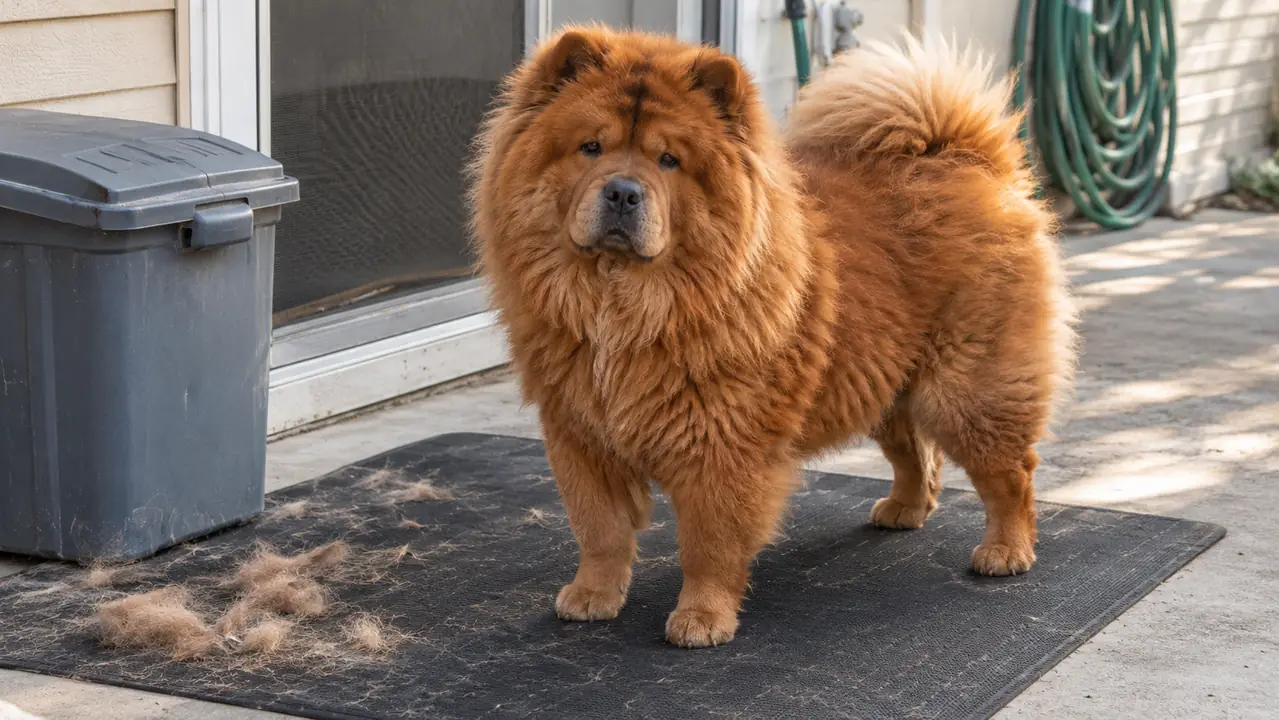
What it did not fix: shedding. A Chow sheds. A Chow with a double coat sheds twice a year in a way that looks like something happened in the night. This brush makes the shed hair come out on my schedule instead of on the tile floor, and that is a real improvement, but it is not a cure, and the tidy little pile of fur in the listing photos understates what April actually looks like at my house.
It also did nothing for the damp ruff problem, because that was a different tool entirely. That was the dryer, and it came out of the hot spot Bruno had on his neck in August 2025, tucked under the ruff where I could not see it. A coat dried down to the skin is a coat that is not sitting damp against the skin for hours. The slicker is part of the coat care. It is not the whole of it, and I would be lying if I sold it to you as the whole of it.
The Routine, Step by Step, If You Want to Copy It
He comes in from the yard at dusk. I sit on the tile with my back against the cabinet, because he will not stand for this and I stopped arguing about it in February. Brush in the left hand, right hand flat on his chest, which is his one soft spot. Ruff first, in the direction the coat grows, short strokes, a few seconds in each spot.
Then behind the ears, one at a time, and the right ear goes first because he is less patient by the time I reach the left. Then the pants, working down from the top of the leg in sections. The tail gets the back of the brush, not the pins. Then I press the button over the bin, and he gets a piece of something, and he goes to bed believing the whole evening was his idea. That is the goal, every night.
Who This Is For
If you have a double-coated dog, you are doing the coat yourself, and you want one daily tool that keeps the small tangles from becoming big ones, this brush is a sensible buy. It is light enough for hands that are not what they were. The retracting pins are a real convenience rather than a novelty. It has held up to ten months of near-daily use on a coat as thick as Bruno's, which is a fair test of any brush.
It is also a reasonable first slicker if you are coming off a pin brush and do not yet know what the difference feels like. It will show you. The first time you see how much comes out of the undercoat after the topcoat already looks completely brushed, you will understand what the pin brush was missing all those years.
Who Should Skip It
If your dog's coat is matted down to the skin, do not buy this. Book a groomer. A slicker on a felted coat wastes your evening and is unkind to your dog, because it pulls at the knot from above without ever releasing it. Same story if what you want is a deshedding tool. This is not one. Get a rake for that, use it weekly, and make peace with the fact that you will still be sweeping.
Skip it too if your dog will not hold still for even a minute. That is the wrong tool at the wrong stage. Work on the standing still first, with treats and very short sessions, or pay someone who does this all day. No brush makes a dog accept being handled, and any review that claims otherwise is selling you something.
Ten months in, the WOPQAEM slicker is the tool I reach for without thinking about it, and for a brush that is the highest thing I can say. It is not exciting. It did not solve everything. It has one job, it does that job every evening in about five minutes, and it has not once given me a reason to go looking for something else.
What I Liked
- Light, about five ounces, and easy on a hand with arthritis
- Angled fine pins reach the undercoat instead of skating over the topcoat
- The release button clears the hair in seconds, so it stays in daily use
- No new mats behind the ears after three weeks of daily brushing
- Held up through ten months of near-daily use on a thick double coat
- Comfortable oblong handle that does not need a hard grip
Where It Falls Short
- Will not break up a mat, at all, and should not be asked to
- Fine pins bend if the brush is dropped on concrete
- Fills up fast during a coat blow, so the routine runs longer in April and October
- Does not reduce shedding the way a rake does, only tidies what is loose
If You Are Doing the Weekly Rake but Not the Daily Five Minutes, Start Here
The rake handles the coat blow. This handles the other fifty weeks, the ones where the tangles form quietly behind the ears.
Amazon Check Today's Price on Amazon →